Newfield’s New Baby

June 6, 2008

Undisclosed sources say that Newfield’s Chermingat has produced first oil, but is undergoing problems typical of all newborns. Does that mean there are opportunities for nannies to help smoothen the transition? Can IGL Process Solutions provide this help?

Chermingat is located in Block PM323 offshore Peninsular Malaysia. She was built by Oilfab, with the engineering services done by MMC Oil & Gas Engineering. Ah, I remember the days when mmogel (such a weird shorthand) was an excellent company to work with. Most of the old and trusted process engineers of now have passed through its doors, passed through being the operative word.


Onshore Exploration Acerage

June 4, 2008

Why doesn’t Malaysia have producing onshore oil and gas acreage? Neighbours Sumatra and Jawa have tonnes of onshore wells, as a friend of mine says, every 100 meters.

Looking at a map (sorry people, inside info only), the only onshore acreage on the Peninsular is PM322, which comes inland at Kelang Port and Western Johor (ah, that Muar mee bandung).

Looking at East Malaysia, there are 4 onshore acreages in Sarawak (SK331-334) and 4 in Sabah (SB330-332/336). Again, these lie along the coastline. I don’t believe these have ever been open for tenders and bids.

Ironic that the ‘Old Lady of Miri,’ Malaysia’s first oil producing well was onshore. Now all of Malaysia’s wells are offshore.

 Wouldn’t it be funny if we have a drilling rig raised next to the Sultan Abdul Samad bridge in Muar? or next to the Second Link?


Expensive Trees

June 3, 2008

A tale told me. A manager reminiscing about the past describes how during a discussion, he wondered why christmas trees were sooo expensive. Was the company getting a bum deal?

Hah, talk about confusing terminology. To the layman, a christmas tree is:

Children\'s tree

To oil and gas engineers, a christmas tree is:

Notice the lack of leaves, needles and decorations.


Saturday New Straits Times 08-05-31 – Job Opportunities

June 2, 2008

I’m changing loyalties this week, mainly because I’m travelling and picked up the first Malaysian newspaper lying around on the plane seat.

I’ve only seen one advert for engineers by Talisman. The advert looks as if the printer ran out of magenta, as the whole print is green.

Have fun. 


Hardship in the Jungle

June 1, 2008

As I’m wondering around Sumatera, I manage to take a peek at a base camp for one multinational company. Much nicer, more spread out than an itty bitty platform in the middle of the South China Sea.


Breakthrough – Women Operators

May 31, 2008

I was touring the depths of Sumatra, and came upon a gas processing plant near Jambi. It’s very intricate, with a condensate recovery system, refrigeration and compression.

Among it all, I found that there were women operators working on the plant. Wow, that’s one area where the Malaysian and Indonesian oil and gas cultures have a difference. Never mind that it’s on land. I understand that the ladies are locals, so that’s a two-for-one advantage, improving the welfare of the local community.

Now, when will we see the same situation in Malaysia?


Enhanced Oil Recovery – the Malaysian Experience

May 30, 2008

I’ve found the Schlumberger Oilfield Glossary to be a useful source of info, helping me figure out where Enhanced Oil Recovery is used in Malaysia.

  • Water Alternating Gas (WAG) is a EOR method which has been looked at. I believe PRSS was looking at it when they still existed.
  • Chemical EOR is being tested as a pilot project at PCSB’s Angsi asset. Akaline surfactant is injected into the reservoir to reduce water flood residual oil saturation.  
  • I believe EMEPMI is looking at WAG, though I don’t know whether it’s a table top exercise, or they have moved to field trials.

At USD 129 / barrel, EOR is definitely more profitable.

If you know more, please write in, esp. as to what is happening in East Malaysia.


Saturday Star 08-05-24 – Job Opportunities

May 27, 2008

Another week, another scan of the Saturday Star newspaper. Here’s a list of job ads in the paper:

  • Technip has a 2 page spread for engineers. Visit their website.
  • Occidental Petroleum of Qatar Ltd as an ad. Occidental was the operator of Piper Alpha, by the way when things hit the fan.
  • Happy hunting. Let me have some feedback if you find this list useful. Even better, spread the news. PayPal donations welcome.

I put in a free advert for my favourite chicken rice place, Chee Meng. Go, people, go! I’m waiting for their loyalty card to come out…


Custody Metering Zen

May 24, 2008

Here’s a dramatically enhanced version of a true story.

An offshore Malaysian oil and gas asset (which shall forever remain nameless unless someone beats the truth out of me) has had some custody metering problems. They have not been able to prove their liquid turbine meters. So, someone from Operations Technical Support goes out to have a look.

The person steps up to the custody metering flow computers, stares at them, becomes one with them, and tells the platform technicians:

“Cool down the computers.”

It turns out that the control room where the computers are mounted and adjoining electrical room have a defective air conditioning system, something about leaking coolent pipes, and the room has been heating up. The flow computers were heated up enough such that electronic errors in the FCs were causing tolerances to be exceeded.

So portable A/C units were directed towards the FCs. Problem solved.

When you reach this level of CT Zen, then you can be called ‘guru’.


How much Oil is there in a Reservoir?

May 23, 2008

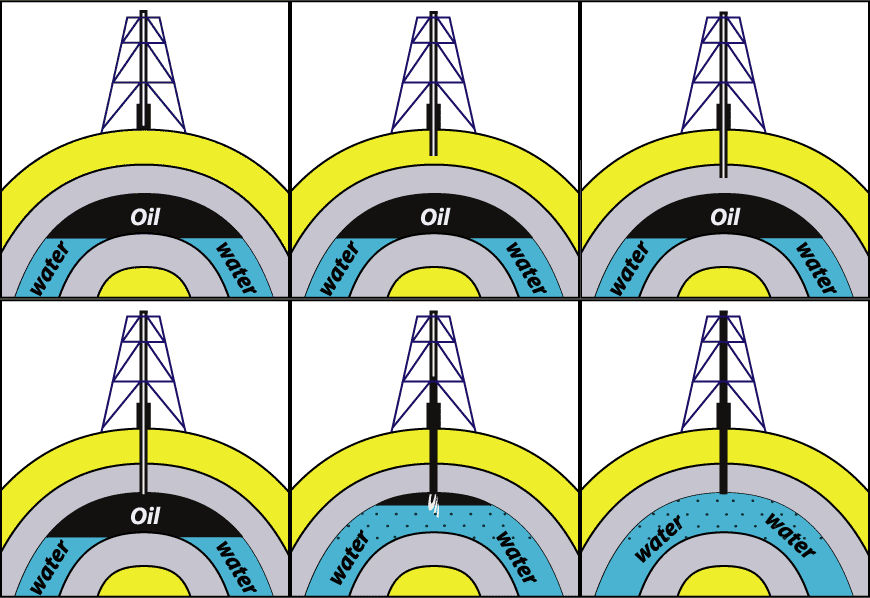
We are all used to diagrams like this:

Oil Reservoir

(hit your browser’s “refresh” button to see this animation again)

It seems as if there is a large cavern underground, where oil swishes and swirls, waiting to be sucked up via the production string. Dream on.

  • Oil is contained within rock. The porosity of the rock is variable, take an average of 20%.
  • Of the oil in the pores (called hydrocarbon in place), perhaps 15-60% is recoverable if you rely on the reservoir pressure ‘squeezing’ the oil into your production string (called primary recovery), and up to the surface. The rest either sticks to the rock, or is not recoverable when pressure is no longer available.

So, out of 1m3 (1000 kl) of rock, you get between 30-120 kl of oil during primary recovery.

How do we get more of the remaining oil out? That’s in an upcoming entry.