Why a Vacuum of Mid Range Senior Engineers?

May 21, 2008

A question asked often is (usually by me when a job I am doing is going pear shaped due to a rush), where are all the Malaysian mid-range engineers? By mid-range I mean those with about 8 -13 years experience.  Are they out there, lurking for the right time to reappear? I hope it isn’t when oil reaches USD 150 / barrel, and pay is given in liquid gold.

My theory is this: I think that when I returned from my studies, engineering was not a favoured career. Everyone wanted to go into finance, then IT, then anything but engineering.

So, let’s do the math. I came back in 1995. So people who entered uni then would leave around 1998-2000. So, they would have 8 years experience.

Allowing for engineers not interested in engineering due to the 1997 financial crisis (engineering projects having been cut back), then engineers would enter uni around 2000, graduate around 2003-5. These would now have 3-5 years experience.

So, us people who entered the engineering field when it was an unglamorous profession… we should be proud. Too bad pride is not a commodity we can sell.


Saturday Star 08-05-18 – Job Opportunities

May 20, 2008

Another week, another scan of the Saturday Star newspaper. Here’s a list of job ads in the paper:

  • Qatargas is looking for Rot Eqt Eng, Fac Eng (hey, my kind of post), Proc Eng, APC (I guess automated process control) Eng. You can apply via email here.
  • SapuraCrest is looking for a whole mess of engineers, that is (long breath) Field Opns, Struc, Pipeline, Naval/Marine, Plan, QA/QC. CVs to be submitted here no later than 31st March.
  • Schlumberger is looking for engineers. CVs to be submitted here.
  • Petrofac is looking for a deputy prod manager & senior operations engineer. CVs to be submitted here,  or fax to HR & Admin Manager +603 2300 2371 (hah, how do you know this isn’t my number?)
  • ExxonMobil is looking for a drilling engineer, though I suspect you can get more money elsewhere. Submit CVs by 31st May, 2008. 
  • And of course, IGL Process Solutions is looking for high paying work, preferably of a 6 month duration.

Happy hunting. Let me have some feedback if you find this list useful. Even better, spread the news. PayPal donations welcome.

I put in a free advert for my favourite chicken rice place, Chee Meng. Go, people, go! I’m waiting for their loyalty card to come out…


Pricing for Engineering Services – Profit Sharing Model?

May 19, 2008

Here’s an idea I got from other businesses. They charge out their services according to the benefit the client receives. An example are energy conservation consultants. They get paid a portion of the energy savings realised by their client.

Imagine translating that into the oil and gas industry. Here’s an example. Say a separator is designed for 100 thousand barrels per day (kbd) of crude. Later, this turns out to be a bottleneck preventing a production increase to 105 thousand kbd (not an unrealistic value). If you use a profit sharing model (say 10% of the production increase), then this translates to 5,000 x 10% x USD50/barrel (I’m using low values here to make a point) =  USD25k a day.

You can pretty much do whatever cost analysis you want. If you think how much you charge using the Engineering, Procurement, Construction and Commissioning (EPCC) method, how much would you get? For debottlenecking a process by changing vessel internals, prob USD500k, of which about 30% would be profit (I’m guessing nos. here).

Which profit model would you like? And if you work for a production company, you should be proud in the rate of return the company gets from you.

At another level, profit sharing is pretty much in vogue for the independent Malaysian oil and gas companies. Profits are shared by issuing stock to employees. Examples of companies that do this are Talisman and Newfield. Examples of companies that do not are ExxonMobil and Shell.


IEM OGMTD Talk – Reservoir Fluids

May 17, 2008

On Saturday, 10th May 2008, I attended a morning tea talk arranged by the Oil, Gas and Mining Technical Division of the IEM, of which I am the SecTreas. The talk was entitled ‘Overview of Drilling and Completion Fluids’. The speaker was Engr. Anwarudin Saidu Mohamed, currently a Coordinator for South East Asia Region with Drilling Fluids, a division of Baker Hughes Inc.

My colleague, Hui Hin, wrote up a summary of the talk. Visit her site to read her write-up.


Gaslift and Coffee Makers

May 16, 2008

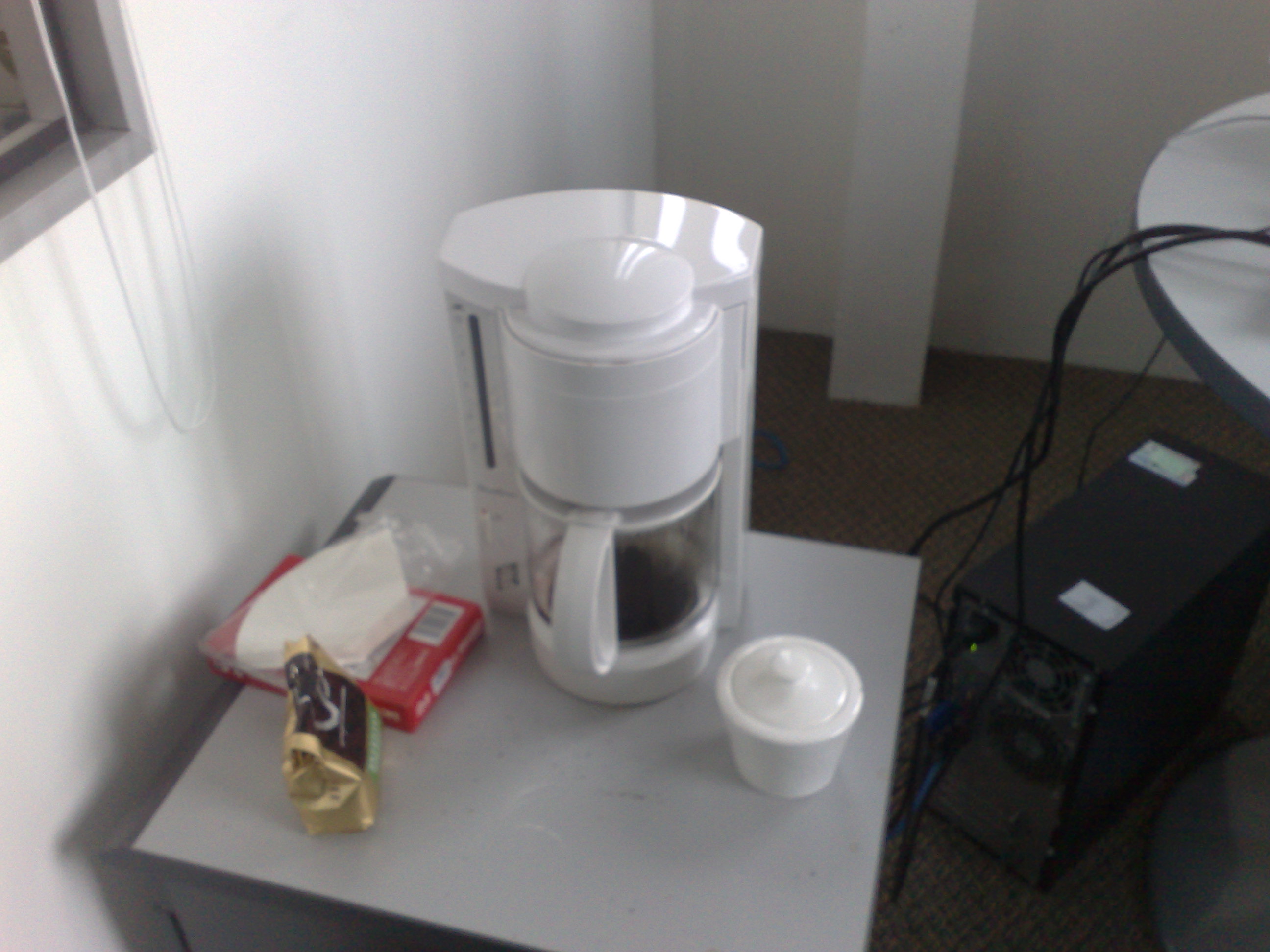
Wata\'s coffee maker

Us being engineers, after the installation of the first coffee maker in my offices (my personal machine Moulinex type W70, my office), the discussion wandered round to how exactly it worked.

Wikipedia - Gas Lift diagram Digressing, gas lift as defined in Wikipedia is “one of a number of processes used to artificially lift oil or water from wells where there is insufficient reservoir pressure to produce the well. The process involves injecting gas through the tubing-casing annulus. Injected gas aerates the fluid to reduce its density; the formation pressure is then able to lift the oil column and forces the fluid out of the wellbore.”

As far as I can tell, gaslifting is the only method used in the South China Sea, at least among the Malaysian platforms. Possible reasons are that it’s cheap (gas is always produced with oil out there in the deep blue) and gas is available at higher than required pressures. This is because gas is taken from the export gas line, which is compressed to transmission specs. As this is above gaslift pressure requirements, an additional booster compressor not needed.

The method used mainly on onshore wells is lifting oil with pumps, either mechanically driven (remember the donkey pumps seen in the background in Beverly Hills Cop II?) or electrically driven submersible pumps. Both require power, which is a premium offshore, but might be as close as the local power grid onshore.


Regressing back to my coffee maker, I find that the cold water reservoir is about the same level as the coffee pot. Hot water has to drip through the filter on top of the pot, and produce that black gold. So, how is the water sent up about 15cm? Definitely not with a pump.You’d hear it running, and pumping a hot two phase mixture is a good way to claim warranty about every other month.

Looking round, I find an article that explains that the hot water is carried up from the cold water reservoir through a pipe by rising bubbles of water vapour (formed by boiling water at the bottom of the pipe). This, and the reduction in density due to a liquid-gas mix, is the same process as a gas lift, though cheaper, on a smaller scale and smells a whole lot nicer.

So, oil and gas engineering principles may be found as close as your nearest cuppa. 


Job Opportunities in Kerteh with TCOT/PCSB

May 14, 2008

I notice that many of my readers are searching for opportunities in Kerteh, especially in the oil and gas sector. One such opportunity is with the Terengganu Crude Oil Terminal (TCOT), as the operatorship is being taken over by PETRONAS Carigali Sdn Bhd (anyone remember when they were all housed in Wisma Peladang? Anyone remember Wisma Peladang?). My original post is here.

Anyhoo, If you think you have the appropriate experience and would like to work with Malaysia’s national oil company, you may contact the PCSB PMO (I think) HR Department. Please call the HR Department at 09 866 77 22 and request for Awang Zul or Lala. I suspect PCSB is looking for technicians and engineers.

Please refer back to my blog. Maybe I’ll get a few Imperial credits out of it.


Saturday Star 08-05-11 – Job Opportunities

May 12, 2008

Another week, another scan of the Saturday Star newspaper. Here’s a list of job ads in the paper:

  • IEV is looking for an Operations Engineer. You can apply via email here.
  • Qatar Petroleum is looking for a whole mess of engineers. CVs to be submitted here, though I hear the package isn’t that impressive.
  • RasGas is looking for measurement engineering specialists, mech eng specialists and Snr rotating eqt eng. CVs to be submitted here. I believe RasGas is a JV, one of the partners being ExxonMobil.
  • Murphy Oil is looking Graduate Trainees, surprise surprise. I thought they only went for senior staff, and paid big bucks for them. Times must be a-changing. I also remember one of their senior staff saying, if you quit from Murphy, you’ll never get back in. CVs to be submitted here.
  • Here’s a new one, though I think I have heard of them before. GL Konsult (“We VALUE and Enhance TALENT!”) is looking for everyone. I would say that they are either starting operations, or are a manpower supply house. Anyway, forward a detailed resume with photo here.
  • Shell is looking for graduates. Head to their website and follow Students & Graduates → Gradutes → How to Apply → Register & Apply Now → Register.
  • And of course, IGL Process Solutions is looking for high paying work, preferably of a 6 month duration.

Happy hunting. Let me have some feedback if you find this list useful. Even better, spread the news. PayPal donations welcome.


Costing – Hydrocarbon Production Opex

May 9, 2008

An important aspect of business is how much it costs to produce a product or service. To cover running (also known by the term operational or opex) costs, the cost of production must be less than the selling price of the product (okay, this is very basic). In operations, this covers SWB (salary, wages and benefits), maintenance costs, logistic costs, and others.

How much is the target cost for producing a barrel of oil is? Believe it or not, 10 USD / barrel is considered expensive. I think I’ve seen targets of 2.5 – 5.0 USD / barrel. If you know a better number, your comments are most valued.

Compare this to capital expenditure. The cost to drill and produce from an offshore well may range between USD 15-30M USD, which covers the gamut between a simple well to a horizontal, extended reach well. The smallest platform I’ve seen had at least 3 wells. Topside hardware costs probably start around 70M USD for a simple structure offshore, to the sky as the limit.

 And compare that to cost of engineering. Ah, we lot are an under-appreciated motley crew.


The Geek’s Geek – Fieldbus Home Computer Network

May 8, 2008

As a facilities engineer (usually known as an operations engineer to the rest of the oil and gas trade), I have to deal with instrumentation. I deal with old (aka proven) technology, so most of the gadgets I dealt with send signals via the good old 4-20 mA standard, which is reliable and very well understood.

This standard is old school. Current and upcoming field control technologies heading towards LAN-type data systems. One system you hear of often is the Fieldbus protocol. From the write-ups I’ve seen, it defines protocols for levels 1, 2 and 7 of the OSI model, which corresponds to the physical, data and application layers (read this excellent free book on TCP/IP). Ethernet defines levels 1 and 2.

So theoretically, you can swap up your cheap, off-the-shelf home Ethernet gear with industry standard Fieldbus equipment, as long as you can get software that is able to translate between the data and transport layer (layer 3). What’s stopping you?

If you were a real geek, you’d build a Fieldbus router to access the Internet, and maybe make it IPv6-ready as well.

Trivia: did you know that you can send power over Fieldbus lines?


Why are there no Independent Operators in Malaysia?

May 6, 2008

A question that was asked of me was, why are there no independent oil and gas operators in Malaysia? It’s an intriguing one, for those of us who used to watch Dallas on TV (remember when there were on 2 channels on air, and they didn’t run 24/7?).

Let’s get some definitions out of the way. I refer to the ever reliable Wikipedia:

Supermajors are “the six largest, non state-owned energy companies, as seen in popular financial mediums around the world.” Chances are, if you are asked to name four oil companies, one of them is your national oil company (PETRONAS to me), and the other three are either supermajors, or components of supermajors prior to consolidation. Exxon and Mobil, Conoco Inc. and Phillips Petroleum Company, Abbot and Costello.

Seven Sisters‘ is a term coined by an Italian entrepreneur, Enrico Mattei, that refers to seven oil companies that dominated mid 20th century oil production, refining, and distribution. These were companies that were formed by the breakup Standard Oil of the US. Still huge companies.

Now things become a bit more interesting. Independent oil companies aren’t something you hear of often.

I think is that people confuse independent companies with family or privately owned companies. One definition which I have found is ‘a non-integrated company which receives nearly all of its revenues from production at the wellhead. They are exclusively in the exploration and production segment of the industry, with no downstream marketing or refining within their operations.’

This is taken straight from the Independent Petroleum Association of America’s (IPAA) 2007 Oil and Natural Gas Issues Briefing Book.

Using that definition, we do have independent producers in Malaysia. Examples are  Talisman EnergyLundin Oil and Newfield.

Not every non-supermajor is an independent. Murphy Oil has retail outlets, Nippon Oil Explorationis a wholly own subsidiary of Nippon Oil Corporation.

 Enough definition for ya?