April 2, 2008
Short blog entry today.
“SMART is an acronym for Stormwater Management and Road Tunnel, a project under the Federal Government initiated to alleviate the flooding problem in the city centre of Kuala Lumpur.” It was featured on the National Geographic Channel.
The main touted feature of the SMART tunnel is that it is a dual use tunnel. In normal mode, it’s a road tunnel. If there is a need to divert water away from Kuala Lumpur to prevent flooding, then the tunnel gets converted to a big stormwater tunnel. When the situation gets better, its converted back to a road tunnel.
My question is: how do they clean up the mud and gunk that is carried into the tunnel with the stormwaters prior to putting it into road tunnel mode? Is it a manual job, or is automated?
 4 Comments |
  engineering, Malaysia | Tagged: clean up, Kuala Lumpur, SMART tunnel |
  Permalink
 Posted by Wata
April 1, 2008
Continuing my expansion of the above article, I thought I would comment on the map that is displayed in the article.
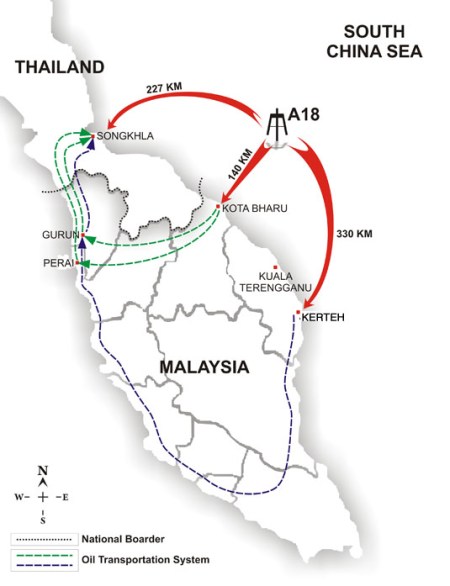
First thing I would like to point out is that the author says the green and blue line represents an oil transportation system.
At the moment, peninsular Malaysia has no oil transportation system. And there are no plans to have a consumer level transportation system (i.e. from refinery to distribution centre, to being piped into petrol stations and the like).
However, the blue line can be said to represent the Peninsular Gas Utilization (PGU) routing. To quote from the website:
“Through its listed subsidiary PETRONAS Gas Bhd, PETRONAS has since 1984 been implementing the three-phase Peninsular Gas Utilisation (PGU) project, an infrastructure development project to process and transmit natural gas fed from the fields offshore Terengganu to end-users in the power, industrial and commercial sectors. The entire PGU system now spans over 1,700km, comprising main gas transmission pipelines, supply pipelines and laterals.”

That covers the blue pill. Let’s chat about the green pill some other time.
10 Comments | engineering, Malaysia, oil and gas | Tagged: gas, Kelantan, oil, Petronas, petronas gas, pgu, semenanjung | Permalink
Posted by Wata
March 30, 2008
Another week, another scan of the Saturday Star newspaper. Here’s an incomplete list of job ads in the paper, though this week’s offerings seem a bit thin on the ground:
-
MECIP is looking people. MECIP is a multi-discipline engineering company providing project engineering, project management, engineering studies and process engineering simulation services.
-
An interesting prospect is
KBR, which has an add for a Singapore position. KBR is a leading global engineering, construction and services company supporting the energy, petrochemicals, government services and civil infrastructure sectors.
-
SapuraCrest has an ad out. Sapura Group through its subsidiary, SapuraCrest Petroleum Berhad [SAPCRES], is one of the leading and reputable integrated technology & service providers in the Oil & Gas industry
Happy hunting. Let me have some feedback if you find this list useful. Even better, spread the news.
10 Comments | engineering, Malaysia, oil and gas | Tagged: jobs, KBR, MECIP, Sapura, SapuraCrest, star | Permalink
Posted by Wata
March 29, 2008
I was working at the Onshore Slug Catcher (OSC) yesterday, performing tasks related to custody measurement. At about 3 o’clock, word came down that there was a accident in front of the Terengganu Crude Oil Terminal (TCOT). From secondhand information, it seems that a Proton was turning right into the TCOT offroad to perform a U-turn. A Sorento attempted to overtake the Proton at the same moment it was turning in.
The above scenario ended up with the Sorento taking a barrel roll, producing 6 victims. I saw the cars being towed in the direction of Paka at 7 pm. The Proton looked as it had been side swipped, whereas the Sorento had one side crushed in.
The Kawasan Industri Petroliam PETRONAS (KIPP) in front of the TCOT is undergoing extensive roadwork. The traffic flow also changes frequently, as they upgrade the road from two to four lanes. Traffic is fast, taking advantage of the already upgraded section. All this adds up to a dangerous and deadly situation.
I hope that authorities (not sure whether that is PETRONAS or the local Terengganu council) improve the situation, providing better traffic control, and finish the road upgrade soon.
1 Comment | Malaysia | Tagged: accident, OSC, Petronas, TCOT | Permalink
Posted by Wata
March 28, 2008
Let’s start with some prices. Looking at Honda Malaysia:
Apparently, a hybrid is a CBU (completely built up unit), fully imported, which has a higher tax then the CKU (completely knocked down), assembled in Malaysia, normal Civic, in addition to whatever actual cost difference between the two.
Now, in the current regime of crude oil prices north of USD100, why doesn’t Proton get onto the bandwagon, and start developing hybrid cars? Once you get over the capital cost of purchasing a hybrid (and make no mistake, there will be a premium), then we can start reaping the benefits of better fuel efficiency, less smog in Kuala Lumpur’s daily traffic jams, and goodwill from having the national car manufacturer heading green. And possibly think of reducing Malaysia’s oil subsidy.
A look at Proton’s press releases reveals:
So, Proton could have implemented hybrid technology probably by this year, but we have yet to see any commercial models, of which the latest launch was in April 2008. Why is that, I ask? Anyone have any info?
4 Comments | engineering, Malaysia, Uncategorized | Tagged: Honda, hybrid, Malaysia, proton | Permalink
Posted by Wata
March 26, 2008
On Tues, 25th March, 2008, the staff at Terengganu Crude Oil Terminal (TCOT) were informed that TCOT and the Onshore Slug Catcher (OSC) will be changing operatorship. By 1st quarter 2009, PETRONAS Carigali Sdn Bhd (PCSB) will be operating TCOT and OSC. ExxonMobil Exploration and Production Malaysia Inc. (EMEPMI) staff currently working at the two locations will be offered a voluntary separation scheme (VSS).
TCOT and OSC are located in the picturesque town of Kertih, Terengganu, Malaysia. TCOT is the terminal for all the offshore oil pipelines, whereas OSC, together with the PCSB operated Onshore Gas Terminal (OGT) are the collection points for offshore gas.
Carigali will send a handover team over on 1st April 2008, with the intention to be ready for full transfer of operatorship by 31st August, 2008.
11 Comments | engineering, Malaysia, oil and gas | Tagged: crude, EMEPMI, gas, Kerteh, Kertih, OGT, OSC, PCSB, Petronas, TCOT, terengganu, terminal | Permalink
Posted by Wata
March 26, 2008
An interesting article appeared in the pages of the Feb 2008 issue of the Jurutera, the Institution of Engineers, Malaysia’s monthly bulletin. It claims that during the haze season, a gas turbine (GT) can lose as much as 3% of its power output.
For those of you who are not from south east Asia, the haze is a polite term for seasonal smog mostly generated by Indonesia and generously shared with the rest of the region.
To quote the article, written by Engr. Dr Philip Tan, Mr. Loh Tian Ek and Mr. Ng Yan Fu,:
-
‘The (GT) output reductions could reach as much as 3%.”
-
“However, to our amazement, the additional power loss would recover when the haze is (sic) cleared.”
-
“… hypothesized that during the haze period, the oxygen concentration per volume of air could be lowered.”
The article provides stoichiometric equations demonstrating the effects of lowered oxygen content.
I would say that if the air quality is bad enough to cause a GT to have a reduced power output, pity the lungs of biological machines.
4 Comments | engineering, Malaysia | Tagged: haze, IEM, power output, reduction, smog, turbine | Permalink
Posted by Wata
March 24, 2008
The Malaysian oil and gas engineering fraternity seems surprisingly small. I don’t know whether it’s because people job hop a lot, hence old colleagues turn up in unexpected places. Perhaps a Malaysian engineer’s goodwill (‘ihsan’ in my old Perdagangan subject) and reputation spreads more rapidly than you’d expect, thereby making it seems that I know a person, but it turns out that the one big break (or big foobar) of her career has been magnified, embellished and edited for an additional shock factor. Or it could be that the community is small, for a reason I will pursue in another entry.
What I would like to ask is, why would an engineering company provide assistance to another, especially one that might be considered a current or future competitor? Examples of such help would be seconding your engineers to work in a competing company. An example would be seconding people between MMC, Ranhill Worley Parsons, or Technip. They are all in the EPCC market, and I presume would like more work then they could cope with. It seems even stranger if you consider niche skills, examples of which are flow assurance, HAZOP and HAZID facilitation, custody measurement and dynamic simulation. Why help each other?
The secondee’s company might be considered as manpower supply company if it’s not careful, with the receiving company getting all the glory. Is this situation a reflection of the above small community, where friendships and the requirement to keep good relations outweighs the benefits of watching your competitor take a dive? Or do you hope that your goodwill is reciprocated such that you will be the favoured partner of choice? Or is the company in a do or die situation, a survival mode where it will do strange and terrible things so that it may live?
5 Comments | engineering, Malaysia, oil and gas | Tagged: competition, secondment | Permalink
Posted by Wata
March 23, 2008
Another week, another scan of the Saturday Star newspaper. Here’s an incomplete list of job ads in the paper:
-
PearlGTL is looking people. Sounds interesting, a GTL company which is undergoing a project in the UAE. A Shell project.
-
An interesting prospect is
m3nergy, a local company.
-
-
Oryx in Kuwait have some positions available. Another GTL opportunity. They are a JV between the ever loved Qatar Petroleum and Sasol of South Africa.
Happy hunting. Let me have some feedback if you find this list useful.
Leave a Comment » | Malaysia, oil and gas | Tagged: M3nergy, Murphy, oryx, Pearl GTL | Permalink
Posted by Wata
March 21, 2008
Continuing my expansion of the above article, I thought I would list down the operators and comments of the acreage listed.
-
Blok A18 – as the original author says, the acreage is operated by the Carigali Hess Operating Company (
CHOCas its known to friends). It’s located in the Malaysia Thailand Joint Development Area (JDA)
- Blok B17 – the PSC for this area is PETRONAS Carigali (JDA) Sdn Bhd, also in the JDA.
- Block C19 – the PSC for this area is Carigali-PTTEP International Operating Company (CPOC), also in the JDA.
- PM3 – operated by Talisman (Malaysia) Ltd.
- Sub-Blok Ular – operated by PETRONAS Carigali Sdn Bhd (PCSB).
- PM301 & PM302 – CS Mutiara, though I’m not sure if they have had to relinquish the acerage yet. It’s interesting to note that this aceragetouches the Kelantanese shoreline.
- PM303 – Shell, PSC awarded in 1999, though yet to produce.
-
So, of the fields listed by the author, 3 are in the JDA, one is in Kelantanese waters, and the rest are in Terengganu waters.
It’s interesting to note that we do not have a JDA for disputed resources between Malaysia, Indonesia and Brunei. Would that have reduced the amount of hydrocarbons that could be claimed by Sabah and Sarawak?
1 Comment | engineering, Malaysia, oil and gas, Uncategorized | Tagged: gas, JDA, Kelantan, Malaysia, oil, petroleum, Petronas, psc, thailand | Permalink
Posted by Wata


