April 1, 2008
Continuing my expansion of the above article, I thought I would comment on the map that is displayed in the article.
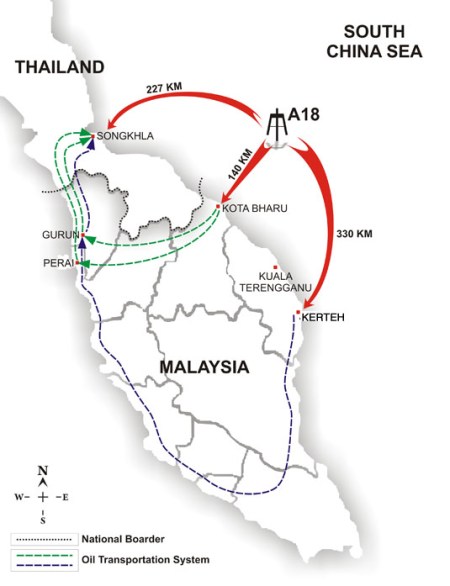
First thing I would like to point out is that the author says the green and blue line represents an oil transportation system.
At the moment, peninsular Malaysia has no oil transportation system. And there are no plans to have a consumer level transportation system (i.e. from refinery to distribution centre, to being piped into petrol stations and the like).
However, the blue line can be said to represent the Peninsular Gas Utilization (PGU) routing. To quote from the website:
“Through its listed subsidiary PETRONAS Gas Bhd, PETRONAS has since 1984 been implementing the three-phase Peninsular Gas Utilisation (PGU) project, an infrastructure development project to process and transmit natural gas fed from the fields offshore Terengganu to end-users in the power, industrial and commercial sectors. The entire PGU system now spans over 1,700km, comprising main gas transmission pipelines, supply pipelines and laterals.”

That covers the blue pill. Let’s chat about the green pill some other time.
 10 Comments |
  engineering, Malaysia, oil and gas | Tagged: gas, Kelantan, oil, Petronas, petronas gas, pgu, semenanjung |
  Permalink
 Posted by Wata
March 30, 2008
Another week, another scan of the Saturday Star newspaper. Here’s an incomplete list of job ads in the paper, though this week’s offerings seem a bit thin on the ground:
-
MECIP is looking people. MECIP is a multi-discipline engineering company providing project engineering, project management, engineering studies and process engineering simulation services.
-
An interesting prospect is
KBR, which has an add for a Singapore position. KBR is a leading global engineering, construction and services company supporting the energy, petrochemicals, government services and civil infrastructure sectors.
-
SapuraCrest has an ad out. Sapura Group through its subsidiary, SapuraCrest Petroleum Berhad [SAPCRES], is one of the leading and reputable integrated technology & service providers in the Oil & Gas industry
Happy hunting. Let me have some feedback if you find this list useful. Even better, spread the news.
10 Comments | engineering, Malaysia, oil and gas | Tagged: jobs, KBR, MECIP, Sapura, SapuraCrest, star | Permalink
Posted by Wata
March 26, 2008
On Tues, 25th March, 2008, the staff at Terengganu Crude Oil Terminal (TCOT) were informed that TCOT and the Onshore Slug Catcher (OSC) will be changing operatorship. By 1st quarter 2009, PETRONAS Carigali Sdn Bhd (PCSB) will be operating TCOT and OSC. ExxonMobil Exploration and Production Malaysia Inc. (EMEPMI) staff currently working at the two locations will be offered a voluntary separation scheme (VSS).
TCOT and OSC are located in the picturesque town of Kertih, Terengganu, Malaysia. TCOT is the terminal for all the offshore oil pipelines, whereas OSC, together with the PCSB operated Onshore Gas Terminal (OGT) are the collection points for offshore gas.
Carigali will send a handover team over on 1st April 2008, with the intention to be ready for full transfer of operatorship by 31st August, 2008.
11 Comments | engineering, Malaysia, oil and gas | Tagged: crude, EMEPMI, gas, Kerteh, Kertih, OGT, OSC, PCSB, Petronas, TCOT, terengganu, terminal | Permalink
Posted by Wata
March 24, 2008
The Malaysian oil and gas engineering fraternity seems surprisingly small. I don’t know whether it’s because people job hop a lot, hence old colleagues turn up in unexpected places. Perhaps a Malaysian engineer’s goodwill (‘ihsan’ in my old Perdagangan subject) and reputation spreads more rapidly than you’d expect, thereby making it seems that I know a person, but it turns out that the one big break (or big foobar) of her career has been magnified, embellished and edited for an additional shock factor. Or it could be that the community is small, for a reason I will pursue in another entry.
What I would like to ask is, why would an engineering company provide assistance to another, especially one that might be considered a current or future competitor? Examples of such help would be seconding your engineers to work in a competing company. An example would be seconding people between MMC, Ranhill Worley Parsons, or Technip. They are all in the EPCC market, and I presume would like more work then they could cope with. It seems even stranger if you consider niche skills, examples of which are flow assurance, HAZOP and HAZID facilitation, custody measurement and dynamic simulation. Why help each other?
The secondee’s company might be considered as manpower supply company if it’s not careful, with the receiving company getting all the glory. Is this situation a reflection of the above small community, where friendships and the requirement to keep good relations outweighs the benefits of watching your competitor take a dive? Or do you hope that your goodwill is reciprocated such that you will be the favoured partner of choice? Or is the company in a do or die situation, a survival mode where it will do strange and terrible things so that it may live?
5 Comments | engineering, Malaysia, oil and gas | Tagged: competition, secondment | Permalink
Posted by Wata
March 23, 2008
Another week, another scan of the Saturday Star newspaper. Here’s an incomplete list of job ads in the paper:
-
PearlGTL is looking people. Sounds interesting, a GTL company which is undergoing a project in the UAE. A Shell project.
-
An interesting prospect is
m3nergy, a local company.
-
-
Oryx in Kuwait have some positions available. Another GTL opportunity. They are a JV between the ever loved Qatar Petroleum and Sasol of South Africa.
Happy hunting. Let me have some feedback if you find this list useful.
Leave a Comment » | Malaysia, oil and gas | Tagged: M3nergy, Murphy, oryx, Pearl GTL | Permalink
Posted by Wata
March 21, 2008
Continuing my expansion of the above article, I thought I would list down the operators and comments of the acreage listed.
-
Blok A18 – as the original author says, the acreage is operated by the Carigali Hess Operating Company (
CHOCas its known to friends). It’s located in the Malaysia Thailand Joint Development Area (JDA)
- Blok B17 – the PSC for this area is PETRONAS Carigali (JDA) Sdn Bhd, also in the JDA.
- Block C19 – the PSC for this area is Carigali-PTTEP International Operating Company (CPOC), also in the JDA.
- PM3 – operated by Talisman (Malaysia) Ltd.
- Sub-Blok Ular – operated by PETRONAS Carigali Sdn Bhd (PCSB).
- PM301 & PM302 – CS Mutiara, though I’m not sure if they have had to relinquish the acerage yet. It’s interesting to note that this aceragetouches the Kelantanese shoreline.
- PM303 – Shell, PSC awarded in 1999, though yet to produce.
-
So, of the fields listed by the author, 3 are in the JDA, one is in Kelantanese waters, and the rest are in Terengganu waters.
It’s interesting to note that we do not have a JDA for disputed resources between Malaysia, Indonesia and Brunei. Would that have reduced the amount of hydrocarbons that could be claimed by Sabah and Sarawak?
1 Comment | engineering, Malaysia, oil and gas, Uncategorized | Tagged: gas, JDA, Kelantan, Malaysia, oil, petroleum, Petronas, psc, thailand | Permalink
Posted by Wata
March 20, 2008
I thought I’d comment on the blog entry at kickdefella.wordpress.com. I’m more interested in the oil and gas perspective, and providing some background information.
First, I’d like to mention who owns Malaysia’s hydrocarbon (that is, oil and gas) reserves. Quoting from an article I co-authored for the Institution of Engineers, Malaysia,
"As an outcome of the petroleum crisis of 1973, which was a result of an OPEC oil export embargo by many of the major Arab oil-producing states in response to western support of Israel during the Yom Kippur War, Malaysia realised the importance and the impact that oil had on the local economy. The Petroleum Development Act (PDA) was enacted in 1974, leading to the incorporation of PETRONAS (Petroliam National Berhad) on 17 August of the same year under the Companies Act 1965. It is wholly-owned by the Malaysian government and is vested with the entire ownership and control of the petroleum resources in Malaysia. In essence, any company who wishes to take part in the exploitation of Malaysia's hydrocarbon resources act as a contractor to PETRONAS."
So, PETRONAS is the owner of all of Malaysia’s hydrocarbons, and this will not change until the PDA is amended or repelled in Parliment. Oil ownership is therefore not a drive to take over Kelantan.
Leave a Comment » | Malaysia, oil and gas, Uncategorized | Tagged: analysis, Kelantan, ownership., Petronas | Permalink
Posted by Wata
March 18, 2008
My family and I went to see the fireflies along the Yak Yak river, near Ijok, Kemaman, Terengganu. We went after dinner at Tong Juan, which is in Chukai, and well known among oilman for its stuffed crabs (though to be honest, they aren’t the only stuffed crab game in town).
Turns out that the firefly attraction is not well developed. You have to arrange for a boatman to meet you at the jetty. The boats are equipped with electric motors, so the tour is nice and silent.
The light produced from the stern of the firefly comes from the oxidation of luciferase with luciferin as a catalyst. The reaction is apparently 90% efficient. It got me thinking, is there a place for bio luminescence in the oil & gas industry? One place it could be useful is in the production of Class I Div 2 (or Div 1) lighting sources. There is little heat generated, and possibly requires some sort of pump to mix the two chemicals together. Concerns entrepreneurs have to think about are:
- light intensity (is the light bright enough to be useful).
- cost (the chemicals have to be made, most likely through bio engineering).
- transportability (two chemicals have to be kept oxygen free till the time of use).
- engineering (circulation systems, delivery of oxygen, control mechanisms).
Anyone have any other ideas?
6 Comments | business opportunity, engineering, Malaysia, oil and gas | Tagged: Class I Div 2, Firefly, light source | Permalink
Posted by Wata
March 17, 2008
Another week, another scan of the Saturday Star newspaper. Here’s an incomplete list of job ads in the paper:
-
-
An interesting prospect is
Linc Energy, a gas-to-liquids company in Australia.
-
Cameron, a service provider, has an ad out. My latest dealings with them was regard to their wet gas meter offerings. Valves spring to mind as well. They are having a walk in session this month.
-
Sumatec have some positions available.
-
Ah, the permanent sinkhole for Malaysians,
QP, has an ad, but not for engineers.
-
McDermott has some positions, though I’m not sure where they are as the advert is coming out of Singapore.
Happy hunting. Let me have some feedback if you find this list useful.
Leave a Comment » | business opportunity, engineering, Malaysia, oil and gas | Tagged: Advert, Job opportunities | Permalink
Posted by Wata
March 15, 2008
A phrase that keeps on cropping up with me and my discussion buddies is the term ‘critical mass’. Of the different interpretations we have for this term, I think the best one means that it is the size of technical resources that results in a quantum leap of company income, better control over the projects and activities staff work on, and a perceived breakthrough of barriers that will allow better rates of return. (Never mind that a quantum is the smallest change a system can undergo).
Now, is there a minimum number which is considered critical mass? I would propose that it depends on the following factors:
-
Is the company privately or publicly owned? I know of a flow assurance consultancy where the number of technical staff is … one. The owner (and chief grunt) seems happy, so I suppose that he is at his critical mass.
-
On the other hand, there are companies that are undergoing acquisitions and mergers, so that they have access to a bigger (and possibly more sympathetic) money pool to allow for expansion, and have instant branch companions and name recognition around the world. A recent presentation by
Expro/ Petrotech bring this to mind.
-
From an engineering management perspective, I would posit that critical mass is the level of resources required such that the departure of personnel does not require a large reshuffle of work delegations. In this period of high demand, it seems that every engineering office should be powered by engineers joining and departing through a rotating door. Critical mass should be sufficient that you are happy with the revenue derived from a work base-load, and are solvent enough to have some engineering fat to perform work to that meets quality standards while waiting for new troops (read: new hires) to replace the workplace casualties.
6 Comments | engineering, investment, Malaysia, oil and gas | Permalink
Posted by Wata


