Thoughts on the Price of Petrol

December 13, 2008

As of today (11th Dec, 2008), the price of petrol in Malaysia is RM1.90/liter. Even though this seems good in the face of things, I can’t help but wonder on some topics:

  • Did you notice that the price of natural gas hasn’t changed? If you are going to follow market forces in pricing petrol, why not gas? Is it because gas consumers has more political clout and more to lose if the current low market price for gas goes up? Or is it because the average man in his Produa doesn’t know about it.
  • For comparison, the EIA site has the price of natural gas as USD $5.686 per MMBtu for January 2009. From Gas Malaysia’s tariff site, the cost of gas ranges from RM19.18/mmBtu to RM28.29/mmBtu. That’s $5.38 to $7.93, converted.
  • The low petrol price means that the people’s focus moves away from  improvement of public conveniences, and back towards getting to work in the relative comfort of private vehicles. I believe that engineers, esp the Institution of Engineers, could have done more faster to improve the lot of the commuter, and recruit more converts to communal travel.
  • Low petrol prices means low crude oil prices, which puts my job in jeopardy. But hey, nothing I can do about it except be more diligent in seeking worthwhile jobs.

Article ‘Kenapa BN Mahu Sangat Rampas Kelantan’ – Take 3

April 1, 2008

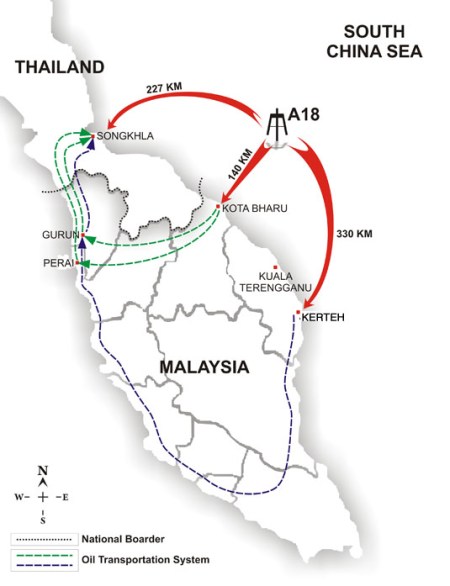
Continuing my expansion of the above article, I thought I would comment on the map that is displayed in the article.

Peta rangkaian hidrokarbon Semenanjung Malaysia

First thing I would like to point out is that the author says the green and blue line represents an oil transportation system.

At the moment, peninsular Malaysia has no oil transportation system. And there are no plans to have a consumer level transportation system (i.e. from refinery to distribution centre, to being piped into petrol stations and the like).

However, the blue line can be said to represent the Peninsular Gas Utilization (PGU) routing. To quote from the website:

“Through its listed subsidiary PETRONAS Gas Bhd, PETRONAS has since 1984 been implementing the three-phase Peninsular Gas Utilisation (PGU) project, an infrastructure development project to process and transmit natural gas fed from the fields offshore Terengganu to end-users in the power, industrial and commercial sectors. The entire PGU system now spans over 1,700km, comprising main gas transmission pipelines, supply pipelines and laterals.”

Peta PGU

That covers the blue pill. Let’s chat about the green pill some other time.


It’s official – TCOT handover from Exxon to PCSB

March 26, 2008

On Tues, 25th March, 2008, the staff at Terengganu Crude Oil Terminal (TCOT) were informed that TCOT and the Onshore Slug Catcher (OSC) will be changing operatorship. By 1st quarter 2009, PETRONAS Carigali Sdn Bhd (PCSB) will be operating TCOT and OSC. ExxonMobil Exploration and Production Malaysia Inc. (EMEPMI) staff currently working at the two locations will be offered a voluntary separation scheme (VSS).

TCOT and OSC are located in the picturesque town of Kertih, Terengganu, Malaysia. TCOT is the terminal for all the offshore oil pipelines, whereas OSC, together with the PCSB operated Onshore Gas Terminal (OGT) are the collection points for offshore gas.

Carigali will send a handover team over on 1st April 2008, with the intention to be ready for full transfer of operatorship by 31st August, 2008.


Article ‘Kenapa BN Mahu Sangat Rampas Kelantan’ – Take 2

March 21, 2008

Continuing my expansion of the above article, I thought I would list down the operators and comments of the acreage listed.

  • Blok A18 – as the original author says, the acreage is operated by the Carigali Hess Operating Company (CHOCas its known to friends). It’s located in the Malaysia Thailand Joint Development Area (JDA)
  • Blok B17 – the PSC for this area is PETRONAS Carigali (JDA) Sdn Bhd, also in the JDA.
  • Block C19 – the PSC for this area is Carigali-PTTEP International Operating Company (CPOC), also in the JDA.
  • PM3 – operated by Talisman (Malaysia) Ltd.
  • Sub-Blok Ular – operated by PETRONAS Carigali Sdn Bhd (PCSB).
  • PM301 & PM302 – CS Mutiara, though I’m not sure if they have had to relinquish the acerage yet. It’s interesting to note that this aceragetouches the Kelantanese shoreline.
  • PM303 – Shell, PSC awarded in 1999, though yet to produce.
  • PM311 & 312 – joint venture between Murphy Peninsular Malaysia Oil Co Ltdand PCSB, yet to produce.

So, of the fields listed by the author, 3 are in the JDA, one is in Kelantanese waters, and the rest are in Terengganu waters.

It’s interesting to note that we do not have a JDA for disputed resources between Malaysia, Indonesia and Brunei. Would that have reduced the amount of hydrocarbons that could be claimed by Sabah and Sarawak?


Malaysian elections equal no shutdown work?

March 3, 2008

Petronas has asked its Production Sharing Contractors (PSC) to defer any shutdown work that might result in gas production cutback till after the Malaysian elections on March 8th, 2008. Is there a concern that a gas shortfall could result in an blackout prior to the elections?

Peninsular Malaysia’s raw gas supply comes from offshore gas fields. The gas is collected into two gas networks and sent to either the Onshore Gas Terminal (OGT) or Onshore Slug Catcher (OSC) in Kertih, Terengganu on the Peninsular’s east coast.

Trivia: Fresh, raw oysters are served in Kertih!