April 10, 2008
Many people have questions about how a foreign engineer can register in Malaysia as an engineer.
The answer lies in the Registration of Engineers Act 1967 (Revised 2002), Section 10A.
My interpretation of the Section is as follows:
- Foreign engineers may only be registered as Temporary Engineers.
- A foreign engineer may only be registered if:
- he possesses the necessary qualification which is recognised for the practice of engineering as a professional engineer in the country where he normally practises; and
- he possesses the necessary expertise and his physical presence is required in Malaysia for not less than one hundred and eighty days in one calendar year or he is a resident representative of the foreign component of a joint-venture.
- The Board of Engineers may approve the registration of a Temporary Engineer for such period not exceeding one calendar year and may renew the registration as it deems fit.
- For the purpose of this section “foreign engineer” means an engineer who is not a citizen or a permanent resident of Malaysia.
So, how do you get around this if you don’t meet the requirements of the Act? Call yourself a ‘consultant’, ‘specialist’, ‘MD’, and other non-aggressive titles. You get the same pay anyway.
 1 Comment |
  engineering, Malaysia, Uncategorized | Tagged: BEM, consultant, engineers, professional engineer, registration, specialist |
  Permalink
 Posted by Wata
April 8, 2008
Liquid flowrate can be measured using two methods:
- Volumetric, where flow is directly measured (turbine meters), or calculated using other process variables (pressure differential in the case of orifice meters). In this case, the volume is multiplied by some form of density to get mass.
- Mass, which is measured using coriolis type meters. To get volumetric flowrates, the mass must be divided by density.
An example where confusion between the two types of methods can result in a financial or accounting problem is determining the amount of free water in a crude flowstream.
The volume fraction of water ismp typically determined on-site using a ‘shakeout’ method. A crude sample is extacted from the process and spun down in a centrifuge to get good separation between the crude and water. A de-emulsifier is typically added to break up the emulsion layer in the sample. The volume of water in the cylinder is the volumetric amount of water in the sample, say anything between 0.5 – 40%.
The details of the above method can be read up in the Manual of Petroleum Measurement Standards (MPMS), Chapter 10-Sediment and Water, Section 4-Determination of Water and/or Sediment
in Crude Oil by the Centrifuge Method (Field Procedure)
2 Comments | engineering, Malaysia, oil and gas | Tagged: coriolis, mass, measurement, MPMS, orifice, turbine, volumetric | Permalink
Posted by Wata
April 7, 2008
Another week, another scan of the Saturday Star newspaper. Here’s an incomplete list of job ads in the paper:
-
-
Giant is looking for management trainees in Kerteh, a prime oil and gas centre. I suspect that it will be located in the white elephant that will be called Kerteh Mall.
-
Pöyry is looking for a whole mess of people in Bangkok, Abu Dhabi, KL, Brunei. Disclosure: I work for Pöyry KL. Hey, apply and say you saw the advert here.
-
-
This is interesting. RasGas is recruiting, but using an agent in Jakarta.
Email address and
here.
Happy hunting. Let me have some feedback if you find this list useful. Even better, spread the news. PayPal donations welcome.
1 Comment | business opportunity, engineering, Malaysia, oil and gas | Tagged: ExxonMobil, Giant, Kerteh, Poyry, Qatar Petroleum, RasGas | Permalink
Posted by Wata
April 4, 2008
Still commenting on the above article, I had some word on the map.
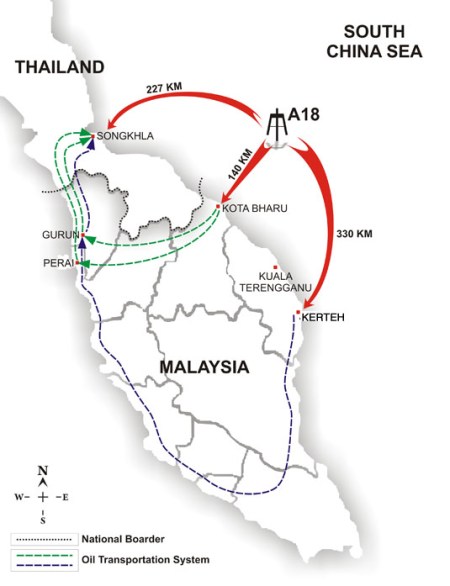
First thing I would like to point out is that the author says the green and blue line represents an oil transportation system.
At the moment, peninsular Malaysia has no oil transportation system. And there are no plans to have a consumer level transportation system (i.e. from refinery to distribution centre, to being piped into petrol stations and the like).
The blue line going from Kota Bharu to Gurun is possibly referring to the Trans-Peninsular Pipeline, which is getting a lot of press release last month (April, 2008). The pipeline will be used to transport crude from Yan to KB, with the intent of saving the travel time to send crude carriers around the Malaysian Peninsular via the Malacca Straits.
You can read articles on the commercial feasibility of the pipeline here and here.
4 Comments | engineering, investment, Malaysia, oil and gas | Tagged: Gurun, Kota baru, Kota Bharu, oil, trans peninsular pipeline, yan | Permalink
Posted by Wata
April 3, 2008
I earlier reported that TCOT / OSC were being handed over to PCSB. Now I can note that ExxonMobil Exploration and Production Malaysia Inc’s (EMEPMI) Production Sharing Contracts (PSC) were extended.
At 3:00 p.m. on Wednesday, March 26, EMEPMI signed with PETRONAS and PETRONAS Carigali the Main Principles Agreement that will lead to the execution of a new Production Sharing Contract (PSC).
In summary, the new PSC will enable EMEPMI to continue production of the existing reserves in the seven fields currently under the 1995 PSC until 2033. It will also be pursuing additional oil development and will have the opportunity to pursue Enhanced Oil Recovery (EOR) activities.
As part of the arrangement, EMEPMI will retain operatorship of all the existing offshore fields, and will extend this to 2033. Operatorship of the onshore assets, and in particular the Terengganu Crude Oil Terminal (TCOT), will be transferred earlier than initially planned, and will be accelerated from 2012 to no later than June 2009 along with the gas and condensate facilities (i.e. OSC). This transfer is strategic to PETRONAS due to national interest considerations.
Other aspects of EMEPM’s current onshore operations at Kemaman Supply Base will
remain as is.
9 Comments | business opportunity, engineering, Malaysia, oil and gas | Tagged: EMEPMI, EOR, KSB, OSC, PCSB, Petronas, psc, TCOT | Permalink
Posted by Wata
April 2, 2008
Short blog entry today.
“SMART is an acronym for Stormwater Management and Road Tunnel, a project under the Federal Government initiated to alleviate the flooding problem in the city centre of Kuala Lumpur.” It was featured on the National Geographic Channel.
The main touted feature of the SMART tunnel is that it is a dual use tunnel. In normal mode, it’s a road tunnel. If there is a need to divert water away from Kuala Lumpur to prevent flooding, then the tunnel gets converted to a big stormwater tunnel. When the situation gets better, its converted back to a road tunnel.
My question is: how do they clean up the mud and gunk that is carried into the tunnel with the stormwaters prior to putting it into road tunnel mode? Is it a manual job, or is automated?
4 Comments | engineering, Malaysia | Tagged: clean up, Kuala Lumpur, SMART tunnel | Permalink
Posted by Wata
April 1, 2008
Continuing my expansion of the above article, I thought I would comment on the map that is displayed in the article.
First thing I would like to point out is that the author says the green and blue line represents an oil transportation system.
At the moment, peninsular Malaysia has no oil transportation system. And there are no plans to have a consumer level transportation system (i.e. from refinery to distribution centre, to being piped into petrol stations and the like).
However, the blue line can be said to represent the Peninsular Gas Utilization (PGU) routing. To quote from the website:
“Through its listed subsidiary PETRONAS Gas Bhd, PETRONAS has since 1984 been implementing the three-phase Peninsular Gas Utilisation (PGU) project, an infrastructure development project to process and transmit natural gas fed from the fields offshore Terengganu to end-users in the power, industrial and commercial sectors. The entire PGU system now spans over 1,700km, comprising main gas transmission pipelines, supply pipelines and laterals.”

That covers the blue pill. Let’s chat about the green pill some other time.
10 Comments | engineering, Malaysia, oil and gas | Tagged: gas, Kelantan, oil, Petronas, petronas gas, pgu, semenanjung | Permalink
Posted by Wata
March 30, 2008
Another week, another scan of the Saturday Star newspaper. Here’s an incomplete list of job ads in the paper, though this week’s offerings seem a bit thin on the ground:
-
MECIP is looking people. MECIP is a multi-discipline engineering company providing project engineering, project management, engineering studies and process engineering simulation services.
-
An interesting prospect is
KBR, which has an add for a Singapore position. KBR is a leading global engineering, construction and services company supporting the energy, petrochemicals, government services and civil infrastructure sectors.
-
SapuraCrest has an ad out. Sapura Group through its subsidiary, SapuraCrest Petroleum Berhad [SAPCRES], is one of the leading and reputable integrated technology & service providers in the Oil & Gas industry
Happy hunting. Let me have some feedback if you find this list useful. Even better, spread the news.
10 Comments | engineering, Malaysia, oil and gas | Tagged: jobs, KBR, MECIP, Sapura, SapuraCrest, star | Permalink
Posted by Wata
March 29, 2008
I was working at the Onshore Slug Catcher (OSC) yesterday, performing tasks related to custody measurement. At about 3 o’clock, word came down that there was a accident in front of the Terengganu Crude Oil Terminal (TCOT). From secondhand information, it seems that a Proton was turning right into the TCOT offroad to perform a U-turn. A Sorento attempted to overtake the Proton at the same moment it was turning in.
The above scenario ended up with the Sorento taking a barrel roll, producing 6 victims. I saw the cars being towed in the direction of Paka at 7 pm. The Proton looked as it had been side swipped, whereas the Sorento had one side crushed in.
The Kawasan Industri Petroliam PETRONAS (KIPP) in front of the TCOT is undergoing extensive roadwork. The traffic flow also changes frequently, as they upgrade the road from two to four lanes. Traffic is fast, taking advantage of the already upgraded section. All this adds up to a dangerous and deadly situation.
I hope that authorities (not sure whether that is PETRONAS or the local Terengganu council) improve the situation, providing better traffic control, and finish the road upgrade soon.
1 Comment | Malaysia | Tagged: accident, OSC, Petronas, TCOT | Permalink
Posted by Wata


