From Bernama – Oil And Gas Industry Needs Skilled Manpower And Innovation To New Technology

March 31, 2010

Is the public expecting that an upgrade in the productivity of the average oil and gas worker to come at no cost or pay increment, similar to what they expect of other labour forces, say the police? Also, would big PSCs (yes, I’m talking about you, PETRONAS) stop asking for ’38 years experience in providing the proposed technology’ and help the little guy by taking some risk and being a mentor and test bed to the smaller suppliers and providers? Windows XP is only 9 years old, stop asking for Windows 98!

Taken from Bernama, dateline 2010-03-23:

Skilled manpower and an innovation to new technology, are the biggest challenges faced by the oil and gas industry, says Sarawak’s Assistant Minister of Infrastructure Development and Communication, Datuk Lee Kim Shin.

Lee said the process of providing education and training for the younger generation to meet the industry demand, is a big challenge, as the process takes time.

“The industry is going to get more sophisticated.So,will the challenges. We need therefore to come out with more innovative and new technology to overcome the challenges,” he said, while officiating the launch of the Sixth Getenergy Exploration and Production 2010 here today.

The two-day conference is being held at Universiti Teknologi Malaysia (UTM) International Campus, from March 23-24.


Petronas denies oil field find

March 28, 2010

My take: PETRONAS might be coy with this information until the current royalty issues are sorted out. Or maybe they don’t want to be seen as bailing out the nation in the near future. Or maybe Kuli was just plain wrong.

Can anyone donate a copy of ‘The Young Turks of PETRONAS‘? I’ve been meaning to read it, but haven’t been able to get my hands on it yet. Maybe if it gets translated to the Kindle
, and maybe when the Kindle finally gets to our shores…

Taken from The Star, deadline 2010-03-25:

KUALA LUMPUR: Petronas has strongly denied reports that it has made a big discovery of an oil field which is said to be one of the biggest in the world.

“We adopt a well-established reporting process whereby we make progress report to the board and stake holders as well as to the Government.

“There is no way we are hiding any information with regards to the discovery as we have no intention to hide any news,” exploration and production business vice-president Ramlan A Malek told a media briefing yesterday.

He added that an announcement would have already been made if the company had found a big oil field.

You can subscribe to an online version of the paper at the Bluehyppo site, follow links to e-browse.


From the NST – USM Trio turns Waste to ‘Gold’

February 26, 2010

Taken from the New Straits Times, dateline 2010-02-20:

Universiti Sains Malaysia is introducing its award-winning ViscoLigno, a chemically modified biopolymer that functions as a drilling mud gelling and viscosifying agent. Standing out from other more commonly used additives in mud drilling, the ViscoLigno is made of oil palm waste.

Its inventor, USM Chemical Sciences School lecturer Associate Professor Mohamad Nasir Mohamad Ibrahim, said ViscoLigno would prevent the soil from collapsing during the drilling process.

He said the substance would also allow soil residue to rise to the surface, allowing the drill to go deeper into the earth without getting stuck.

You can subscribe to an online version of the paper at the Bluehyppo site, follow links to e-browse.


From The Star: Exxon and Coca-Cola to invest in Malaysia

November 28, 2009

Dateline 2009-11-14:

SINGAPORE: Two American companies are expected to make substantial investments in the local beverage and gas sectors soon.

Prime Minister Datuk Seri Najib Tun Razak said petroleum firm ExxonMobil Corporation had expressed its intention to venture into high CO2 content gas extraction while beverage giant Coca-Cola wanted to build a new modern plant in Malaysia.

Hah, here’s a funny one. ExxonMobil will be extracting CO2. Coca-Cola products are carbonated, which means they require a CO2 source in the future. What is that upcoming CO2 extraction source, I wonder?

I predict the next Coca-Cola plant will be in Kertih. What say you? “Beverage and gas sectors’ indeed.

BTW, I’ll be in Miri next week. Any more eating place suggestions?


From the Associated Press – Oil dips in Asia on signs of building inventories

March 26, 2009

Dateline 2009-03-26 (story link here):By EILEEN NG – 13 hours ago

KUALA LUMPUR, Malaysia (AP) – Oil prices declined in Asia Wednesday in tandem with a pull back in global stock markets and on signs of building crude inventories.

Benchmark crude for May delivery fell 96 cents to $53.02 a barrel by afternoon Asian electronic trading on the New York Mercantile Exchange. The contract staged a late rally Tuesday to close up 18 cents at $53.98 a barrel.

Oil prices haven’t climbed much higher because the buying has been driven by stock market gains and not because of a real improvement in global oil demand.

A report Tuesday by the American Petroleum Institute showed a build up of crude stock, a day ahead of a U.S. government report on domestic crude inventories, said Victor Shum, an energy analyst with consultancy Purvin & Gertz in Singapore.

Analysts expect a build up of 1.4 million barrels in commercial crude oil stocks in the U.S, the world’s largest energy consumer, a Platts survey showed.

“That is bearish news,” Shum said. “Some caution has crept into the market and expectations that the U.S. government inventory report will show an increase will likely put downward pressure on oil pricing.”

Oil prices rallied all last week and again on Monday amid gains in stock markets and optimism about a U.S. government plan to buy up toxic assets from banks to resolve to financial crisis. A weaker dollar has also caused investors to flee to commodities like oil, which have risen more than 30 percent this month.

Wall Street declined slightly Tuesday, and Asian markets were mixed Wednesday as investors took stock of the recent rally. Analysts said if more good news emerges, stocks could keep climbing. But if they fall back in coming days, oil will likely follow.

“I am not convinced that oil (pricing) is turning around. It’s a short spike on the back of the stock market rally but eventually I expect it to fall back below $50,” said Clarence Chu, a trader with market maker Hudson Capital Energy in Singapore.

With effects of the OPEC production cuts and a global economic recovery likely to kick in late in the year, Chu said he foresee oil demand and price to only bounce back by the second half.

Russian Finance Minister Alexei Kudrin also warned Tuesday that the recent rise in oil and stock prices may be “temporary.”

But the oil rally led China on Tuesday to raise its benchmark retail price of gasoline and diesel fuel.

In other Nymex trading, gasoline for April delivery fell 1.81 cents to $1.4845 a gallon, while heating oil lost 2.31 cents to $1.4765 a gallon. But natural gas for April delivery climbed 0.7 cent at $4.34 per 1,000 cubic feet.

In London, Brent prices shed 87 cents to $52.63 on the ICE Futures exchange.

Sorry, I don’t have a link directly to AP. For us O&G people, USD52/barrel gives us hope that shelved capital projects  will restart again.


APF: Asia’s Biofuel Dreams Shelved

March 4, 2009

Don’t you think the above was a forgone conclusion? Taking this from APF via Google News:

KUALA LUMPUR (AFP) – Hopes of a biofuel bonanza for Southeast Asia, raised when sky-high oil prices made the search for alternative fuels a priority, have been shelved as global fortunes and crude prices nose-dive.

Back when movie stars won plaudits for driving hybrid cars, and grains and oils were going cheap, regional governments grew excited over producing biofuel to lower energy costs and soak up agricultural stockpiles.

Malaysia and Indonesia, which produce most of the world’s palm oil, heavily promoted their version of biofuel — a mixture of diesel with five percent processed palm oil.

But the excitement evaporated as crude oil, which peaked at 147 dollars in July 2008, fell to current levels below 37 dollars.

That triggered a massive drop in palm oil prices from 1,245 dollars per tonne a year ago to 405 dollars per tonne last December.

Although palm oil prices have now recovered slightly to 526 dollars per tonne, supply has been disrupted as many firms shut down production or refuse to sign long-term supply contracts because of the volatile outlook.

The Malaysian government says it will now review 91 biofuel plant licenses issued during the sector’s heyday, as the majority are not operating.

I’m for more efficient fuel consumption.


Why are there no Independent Operators in Malaysia?

May 6, 2008

A question that was asked of me was, why are there no independent oil and gas operators in Malaysia? It’s an intriguing one, for those of us who used to watch Dallas on TV (remember when there were on 2 channels on air, and they didn’t run 24/7?).

Let’s get some definitions out of the way. I refer to the ever reliable Wikipedia:

Supermajors are “the six largest, non state-owned energy companies, as seen in popular financial mediums around the world.” Chances are, if you are asked to name four oil companies, one of them is your national oil company (PETRONAS to me), and the other three are either supermajors, or components of supermajors prior to consolidation. Exxon and Mobil, Conoco Inc. and Phillips Petroleum Company, Abbot and Costello.

Seven Sisters‘ is a term coined by an Italian entrepreneur, Enrico Mattei, that refers to seven oil companies that dominated mid 20th century oil production, refining, and distribution. These were companies that were formed by the breakup Standard Oil of the US. Still huge companies.

Now things become a bit more interesting. Independent oil companies aren’t something you hear of often.

I think is that people confuse independent companies with family or privately owned companies. One definition which I have found is ‘a non-integrated company which receives nearly all of its revenues from production at the wellhead. They are exclusively in the exploration and production segment of the industry, with no downstream marketing or refining within their operations.’

This is taken straight from the Independent Petroleum Association of America’s (IPAA) 2007 Oil and Natural Gas Issues Briefing Book.

Using that definition, we do have independent producers in Malaysia. Examples are  Talisman EnergyLundin Oil and Newfield.

Not every non-supermajor is an independent. Murphy Oil has retail outlets, Nippon Oil Explorationis a wholly own subsidiary of Nippon Oil Corporation.

 Enough definition for ya?


Article ‘Kenapa BN Mahu Sangat Rampas Kelantan’ – Take 4

April 4, 2008

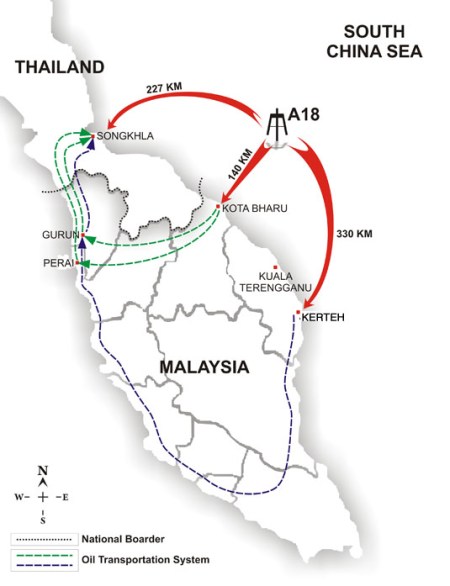
Still commenting on the above article, I had some word on the map.

Peta rangkaian hidrokarbon Semenanjung Malaysia

First thing I would like to point out is that the author says the green and blue line represents an oil transportation system.

At the moment, peninsular Malaysia has no oil transportation system. And there are no plans to have a consumer level transportation system (i.e. from refinery to distribution centre, to being piped into petrol stations and the like).

The blue line going from Kota Bharu to Gurun is possibly referring to the Trans-Peninsular Pipeline, which is getting a lot of press release last month (April, 2008). The pipeline will be used to transport crude from Yan to KB, with the intent of saving the travel time to send crude carriers around the Malaysian Peninsular via the Malacca Straits.

You can read articles on the commercial feasibility of the pipeline here and here.


Engineering Companies – Is there a Critical mass?

March 15, 2008

A phrase that keeps on cropping up with me and my discussion buddies is the term ‘critical mass’. Of the different interpretations we have for this term, I think the best one means that it is the size of technical resources that results in a quantum leap of company income, better control over the projects and activities staff work on, and a perceived breakthrough of barriers that will allow better rates of return. (Never mind that a quantum is the smallest change a system can undergo).

Now, is there a minimum number which is considered critical mass? I would propose that it depends on the following factors:

  • Is the company privately or publicly owned? I know of a flow assurance consultancy where the number of technical staff is … one. The owner (and chief grunt) seems happy, so I suppose that he is at his critical mass.
  • On the other hand, there are companies that are undergoing acquisitions and mergers, so that they have access to a bigger (and possibly more sympathetic) money pool to allow for expansion, and have instant branch companions and name recognition around the world. A recent presentation by Expro/ Petrotech bring this to mind.
  • From an engineering management perspective, I would posit that critical mass is the level of resources required such that the departure of personnel does not require a large reshuffle of work delegations. In this period of high demand, it seems that every engineering office should be powered by engineers joining and departing through a rotating door. Critical mass should be sufficient that you are happy with the revenue derived from a work base-load, and are solvent enough to have some engineering fat to perform work to that meets quality standards while waiting for new troops (read: new hires) to replace the workplace casualties. 

Idea – Feedback of broken rear car lights

March 14, 2008

Have you ever been driving behind a car which does not have working brake lights? Kinda dangerous, especially in KL traffic at 6:30 pm on a rainy evening. It is possible that the driver might not know that his lights have gone kaput, and causing distress to his fellow drivers.

How’s this for an idea. The brake light indicator on the dashboard should provide positive feedback that the all brake lights are lit upon activation of the brakes (in Malaysia that’s at least 3 lights). Maybe it should flash when one or more of the lights do not light up, and be continuously lit when all lights are working.

I got this idea from the oil and gas industry. Compressor startup sequences are notoriously finicky processes. Various steps must be executed within a certain time frame, or the process is aborted. A number of these steps involve opening or closing valves. A command to open or close is sent to the valve through the compressor control panel. Positive feedback is provided via limit switches on the valves. If the valve receives an instruction, say to open, but the limit switch indicates otherwise (valve still closed or partway open), then the whole startup sequence is aborted.

Side note: some organizations keep a record of attempted starts to successful starts. 30 is considered normal.

Note that confirmation of the startup sequence valve position is separate from the control signal sent to the valve. I believe that this idea was taken from the nuclear industry, where they need to know the position of control rods in reactors. I take took this idea, and have applied it to car brake lights, i.e. the brake light status is independent of the brake demand.

Basic engineering question: what is the cost threshold to implement this in cars? Is Proton (Malaysia’s national car manufacturer) interested in the idea?