IEM Shout Out – Technical Visit to Universiti Teknologi Petronas 2016-11

November 10, 2016

This is a shout out for the IEM. My technical division will be hosting a trip to UTP on the 15th November, 2016. You will be anointed with 2.5 CPD hours.

The depleting natural resources and increasing challenges in exploring new oil field has saw the importance of Enhanced Oil Recovery (EOR) in oil production industry. EOR has been recognized by the Malaysian Government as one of the focus area in Oil & Gas NKEA in year 2011.

The Centre of Research in EOR was established in Universiti Teknologi Petronas (UTP) in year 2006 to promote excellence in EOR research that mostly addresses the needs of industry and to manage laboratory services. Research in the area has continuously expanded at UTP since 2006. Most EOR research projects are conducted by the petroleum engineering staff and the topics are mostly conventional topics such as subsurface fluid flow, rock fluid interactions etc. In addition, there is an increasing interest from non-petroleum engineering researching EOR chemicals, application of waves, advanced materials among others.

Offshore engineering has always been a challenge for oil and gas industry, especially in Malaysia, since almost all exploration and production activities in Malaysia derive from offshore. New development in addressing the offshore challenges, both for shallow water and deep-water would be beneficial to the industry to optimize the offshore operation.

The visit to Centre of Research in EOR and Offshore Engineering Laboratory would extent the knowledge of engineers on research areas and applications on EOR and offshore engineering challenges in oil & gas industry.


Register here and get the flyer here.


Shout Out – One-Day Course on Safety Integrity Levels (SIL) 2016-11 Training For Workshop Participants

November 1, 2016

My technical division will be hosting a 1 day seminar on the 15th November, 2016. It is worth 6.5 CPD points, and held at Hilton Hotel. Since I’m giving it, I expect hoards will have to be turned away at the gates. And it’s a big room, so I need to fill the seats.

In the Layer of Protection methodology, a Safety Instrumented Function (SIF) designed to eliminate the cause of a risk or minimize the consequence of an event. The expectation of the SIF’s reliability to perform upon demand must be defined so that it is designed appropriately. The Safety Integrity Level (SIL) study is a tool used this.

This full day course is designed to educate participants in the SIL process from the perspective of a SIL team member. It is meant to provide both instruction and workshop sessions so that the participants:

  • Are familiar with the concept of ‘risk’
  • Are familiar with the theory and terminology behind Layers of Protection, SIS, SIF, SIL and LOPA
  • Are familiar with the different SIL methodologies: risk graph, risk matrix, LOPA.
  • Have expectations as to what the SIL workshop will (and won’t) provide.
  • Understand what deliverables can be expected from a SIL workshop.
  • Have the opportunity to participate in SIL exercise in a safe environment.Opportunity to share SIL experiences.

Wata has 19 years of experience in the oil and gas industry, in both design and operations.

Register here, or download the form here.


Engineer’s Run 2016

October 5, 2016

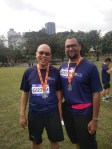
I partook of the 5km run. I think I put off a lot of students at UM from studying engineering.


IEM Shout Out – 2016/10 One Day Course on Demolition Using Explosives

October 4, 2016

My technical division will be hosting a 1 day course on the 20th October, 2016, presented by Brig General Mustapha Omar, Ir. Look Keman Sahari and Ir. Dr. Mohamed Alias Yusof. It is worth 6.5 CPD points, and held at Wisma IEM. I expect that you register using your actual names, not your Pokemon handles.

Malaysia is considered a young country and rapidly developing. We see many new high rise building coming up even on small plot of land in city area. This is due to high cost of land. However, anything that goes up some day, sometimes it will have to come down. It can be due to aging, high cost of maintenance, availability of new technology, new planning by the owner or authority or whatever other reasons. It is very rare when forwarding development plan, the subject of the need for demolition later is ever considered. Bringing down a building or any structure by mechanical means for example will subject the neighbours to vibration, dust noise and numerous other dangers to them for a long time. It may even take several months. There are also incidents where demolition workers were injured and some were killed in line of duty. Demolition by using explosive may require the services of civil/structural engineer working together with the blasters and blasting engineer. The preparation may take months to study the structural plan of the building to be taken down, to survey the surrounding area and plan how to mitigate the effect of airblast, fragmentation, dust and ground vibration.

Hj Look Keman bin Sahari graduated in mining engineering from the University of Strathclyde, Scotland in 1979. He joined the Mines Department initially as Geotechnical engineer specialising in Slope engineering particularly technical investigation on slope failures. He later joined the Inspectorate division of the Department until retirement in 1996. In 1990 he continued his studies at Royal Military College of Science, Cranfield University, England and obtained MSc in Explosives Ordnance Engineering. His interest was then on the use of Shape Charge in the industry. On retirement he worked as Consultant Engineer in the use of explosive for mining, quarrying and construction. He had also served as expert witness in control blasting in Arbitration. As a committee member of IEM Training Board he had attended many courses particularly on Geotechnical Engineering, Health and Safety, forensic engineering and also tunnelling as Auditor. He is a Professional Engineer with Practicing Certificate and a Fellow of IEM. He had also given lecture on explosives application at IEM and Institute of Quarrying, Malaysia. He is also a qualified Shotfirer..

Brig General Mustapha bin Omar is a qualified Ammunition Technical Officer and had rose through the rank in the Malaysian Army  to become to Chief Ammunition Technical officer He is  an expert in the application of military explosives including demolition. He also had a Diploma in Industrial Management from UKM in 1993 and subsequently Bachelor in Business Administration from UPM in 2001. In 2002-2003 he further his studies at Royal Military College of Science, Cranfield University at MSc level in Explosives Ordnance Engineering. He is also knowledgeable in the use of commercial explosives and had attended a Shotfirer Course organised by Institute of Quarrying, Malaysia. He is currently a Senior Research Officer at STRIDE ( Institute Penyelidekan Sains Teknologi Pertahanan)

Associate Professor Ir. Dr. Mohamed Alias bin Yusof obtained his Bachelor Degree in Civil Engineering from UTM in 2002, MSc in Project Management from UITM in 2005 and PhD in Civil Engineering in 2012 from University Pertahanan National Malaysia. He is also a Professional Engineer registered with the Board of Engineer. Dr Alias specialises in the Blast Effect on Structure. He is also knowledgeable in Commercial and Military explosives and had also attended course in Explosives Engineering at Royal Military College of Science, Cranfield University He also attended Shotfirer Course and Blast Vibration, Monitoring and ControlCourse at Institute of Quarrying Malaysia.

Register here, or download the form here.


IEM Shout Out – 2016/10 One Day Course on Demolition Using Explosives

September 20, 2016

My technical division will be hosting a 1 day course on the 20th October, 2016, presented by Brig General Mustapha Omar, Ir. Look Keman Sahari and Ir. Dr. Mohamed Alias Yusof. It is worth 6.5 CPD points, and held at Wisma IEM. I expect that you register using your actual names, not your Pokemon handles.

Malaysia is considered a young country and rapidly developing. We see many new high rise building coming up even on small plot of land in city area. This is due to high cost of land. However, anything that goes up some day, sometimes it will have to come down. It can be due to aging, high cost of maintenance, availability of new technology, new planning by the owner or authority or whatever other reasons. It is very rare when forwarding development plan, the subject of the need for demolition later is ever considered. Bringing down a building or any structure by mechanical means for example will subject the neighbours to vibration, dust noise and numerous other dangers to them for a long time. It may even take several months. There are also incidents where demolition workers were injured and some were killed in line of duty. Demolition by using explosive may require the services of civil/structural engineer working together with the blasters and blasting engineer. The preparation may take months to study the structural plan of the building to be taken down, to survey the surrounding area and plan how to mitigate the effect of airblast, fragmentation, dust and ground vibration.

Hj Look Keman bin Sahari graduated in mining engineering from the University of Strathclyde, Scotland in 1979. He joined the Mines Department initially as Geotechnical engineer specialising in Slope engineering particularly technical investigation on slope failures. He later joined the Inspectorate division of the Department until retirement in 1996. In 1990 he continued his studies at Royal Military College of Science, Cranfield University, England and obtained MSc in Explosives Ordnance Engineering. His interest was then on the use of Shape Charge in the industry. On retirement he worked as Consultant Engineer in the use of explosive for mining, quarrying and construction. He had also served as expert witness in control blasting in Arbitration. As a committee member of IEM Training Board he had attended many courses particularly on Geotechnical Engineering, Health and Safety, forensic engineering and also tunnelling as Auditor. He is a Professional Engineer with Practicing Certificate and a Fellow of IEM. He had also given lecture on explosives application at IEM and Institute of Quarrying, Malaysia. He is also a qualified Shotfirer..

Brig General Mustapha bin Omar is a qualified Ammunition Technical Officer and had rose through the rank in the Malaysian Army  to become to Chief Ammunition Technical officer He is  an expert in the application of military explosives including demolition. He also had a Diploma in Industrial Management from UKM in 1993 and subsequently Bachelor in Business Administration from UPM in 2001. In 2002-2003 he further his studies at Royal Military College of Science, Cranfield University at MSc level in Explosives Ordnance Engineering. He is also knowledgeable in the use of commercial explosives and had attended a Shotfirer Course organised by Institute of Quarrying, Malaysia. He is currently a Senior Research Officer at STRIDE ( Institute Penyelidekan Sains Teknologi Pertahanan)

Associate Professor Ir. Dr. Mohamed Alias bin Yusof obtained his Bachelor Degree in Civil Engineering from UTM in 2002, MSc in Project Management from UITM in 2005 and PhD in Civil Engineering in 2012 from University Pertahanan National Malaysia. He is also a Professional Engineer registered with the Board of Engineer. Dr Alias specialises in the Blast Effect on Structure. He is also knowledgeable in Commercial and Military explosives and had also attended course in Explosives Engineering at Royal Military College of Science, Cranfield University He also attended Shotfirer Course and Blast Vibration, Monitoring and ControlCourse at Institute of Quarrying Malaysia.

Register here, or download the form here.


IEM Shout Out – Talk on “Gaslift System Optimization”

September 17, 2016

My technical division will be hosting a talk on the 21st September, 2016. It is worth 2 CPD points, and held at Wisma IEM. The course will be presented by Ir. Ridhuan Affandi bin Abu Bakar.

Gas lift is one of the most widely used artificial lift techniques. It plays an important role in Malaysia’s oil fields production, as around 70% of active oil production strings are currently on gas lift. This shows how critical gas lift contribution to sustain Malaysia’s oil production. It is important to have good practices in gas lift implementation to ensure successful and optimum gas lift operation. Sub-optimized gas lift operation not only wastes the valuable gas resources and compression capacity but also resulting in a system bottleneck, if the planning for gas lift is not in place. Gas lift optimization can bring value for immediate and significant production gain and perceived as the most cost effective in production enhancement.

As the efficiency of overall gas lift system is much dependent on network integration between subsurface and surface system, a holistic view on performance and setup of each system is crucial to obtain optimum gas lift operation.

This talk will cover and discuss the gaps identification in the current gas lift implementation from the Surface Engineering’s perspective. The recommendation and best practices for gas lift optimization effort with associated oil gain will also be discussed and shared in this talk

Ir. Ridhuan Affandi bin Abu Bakar graduated from Universiti Putra Malaysia with a degree in Chemical Engineering. He has 10 years of working experience in the engineering industry, covering the design of onshore and offshore facilities. He has involved in conceptual, FEED (Front End Engineering Design), detailed design and modification projects for various types of structures (including wellhead platforms, central processing platforms, FPSO, production-drilling platforms and living quarter (PDQ)

He has worked on a number of projects globally including Singapore, Vietnam, United Kingdom and Iran. Recently, he has represented PETRONAS MPM (Malaysia Petroleum Management) to conduct assessment and evaluation on gas lift operation for the selected fields and Oil & Gas Operators in Malaysia.

He is currently a Process Specialist who provides consultancy services to the Oil & Gas industry.

Register here, or download the form here.


IEM Shout Out – Technical Writing Workshop 2016-10

September 15, 2016

This is a shout out for the IEM. My Technical Division will hosting the above seminar on the 4th and 5th October, 2016, presented by Ir. Danaraj Chandrasegaran.

This two day course is designed to help you develop skills that will enable you to produce clear and effective technical documents. We will focus on the basic principles of good writing which technical writing shares with other forms of writing and on types of documents common in technical fields and organizations. While the emphasis will be on writing of technical information, oral communication will also form an important component of the course as well.

Participants learn the protocol for proper technical report writing. Subjects include punctuation, grammar and research techniques, as well as the creation of title pages, tables of contents, format pages, glossaries and appendices. It will also cover other common engineering documents such as specifications, technical reports, operating manuals and emails. The workshop will also emphasize style, tone and the importance of writing in plain, comprehensible English.

As a great deal of class time will be spent in a variety of interactive formats, active participation is essential.

Ir. Danaraj Chandrasegaran, PEng, MIEM, CEng, MIMechE graduated from University Teknologi Malaysia in 2001 with Bachelor of Mechanical Engineering (Hons), subsequently, pursued his Master Degree in University of Malaya. He has published in international journals and conferences in the past. His career has a diverse outlook on project execution ranging from building construction, marine, mining and energy industry; as a mechanical engineer. He is also a Chartered Engineer of Engineering Council UK and Corporate Member of Institution of Mechanical Engineers (UK).

You can register for the above event here, and flyers may be obtained here.


IEM Shout Out – Talk on “Gaslift System Optimization”

September 7, 2016

My technical division will be hosting a talk on the 21st September, 2016. It is worth 2 CPD points, and held at Wisma IEM. The course will be presented by Ir. Ridhuan Affandi bin Abu Bakar.

Gas lift is one of the most widely used artificial lift techniques. It plays an important role in Malaysia’s oil fields production, as around 70% of active oil production strings are currently on gas lift. This shows how critical gas lift contribution to sustain Malaysia’s oil production. It is important to have good practices in gas lift implementation to ensure successful and optimum gas lift operation. Sub-optimized gas lift operation not only wastes the valuable gas resources and compression capacity but also resulting in a system bottleneck, if the planning for gas lift is not in place. Gas lift optimization can bring value for immediate and significant production gain and perceived as the most cost effective in production enhancement.

As the efficiency of overall gas lift system is much dependent on network integration between subsurface and surface system, a holistic view on performance and setup of each system is crucial to obtain optimum gas lift operation.

This talk will cover and discuss the gaps identification in the current gas lift implementation from the Surface Engineering’s perspective. The recommendation and best practices for gas lift optimization effort with associated oil gain will also be discussed and shared in this talk

Ir. Ridhuan Affandi bin Abu Bakar graduated from Universiti Putra Malaysia with a degree in Chemical Engineering. He has 10 years of working experience in the engineering industry, covering the design of onshore and offshore facilities. He has involved in conceptual, FEED (Front End Engineering Design), detailed design and modification projects for various types of structures (including wellhead platforms, central processing platforms, FPSO, production-drilling platforms and living quarter (PDQ)

He has worked on a number of projects globally including Singapore, Vietnam, United Kingdom and Iran. Recently, he has represented PETRONAS MPM (Malaysia Petroleum Management) to conduct assessment and evaluation on gas lift operation for the selected fields and Oil & Gas Operators in Malaysia.

He is currently a Process Specialist who provides consultancy services to the Oil & Gas industry.

Register here, or download the form here.


IEM Shout Out – 2016-10 One-Day Course on “Offshore Sand Separation, Design, Operation and Maintenance”

September 1, 2016

This is a shout out for the IEM. My Technical Division will hosting the above workshop on Thursday 29th September, 2016 by Mr. Hilmi Isa and Eow John Son.

n the upstream offshore oil & gas production, effective and efficient sand separation and management are vital, since the presence of sand and solids in wellhead production lines are likely to cause erosion and blockage issues in the subsequent downstream equipment at production platforms. As a consequence, dangerous incidents, such as the failures of flowlines, production vessels and control valves, have a higher risk of occurring. Moreover, oily sand discharged into the sea is also an environmental concern.

This full-day course is designed to educate the participants on the engineering design, operation and maintenance of the technologies for the removal and cleaning of the sand and solids prior to discharge. Proven sand removal technologies, such as wellhead desanders, produced water desandinghydrocyclones, sand fluidisers, and sand cleaning systems are commonly used in the upstream oil & gas production. However, these sand removal and cleaning systems need to be designed and operated correctly to ensure optimized separation performance.

Mr. Hilmi Isa is Managing Director and Principal Trainer of EDES Technology Sdn Bhd. Hilmi has worked in the oil & gas industry for 20 years specializing in mechanical and process designs for production and processing equipment. Hilmi has worked as Lead Mechanical Engineer for many upstream oil & gas projects, covering wellhead desanders, produced water treatment, sand separation and management, seawater treatment, multiphase production separators, fuel gas treatment, and glycol gas dehydration. Hilmi is also well-versed in the PETRONAS Technical Standards (PTS) and the SHELL DEP Standards. He has also successfully conducted technical training programs for PETRONAS and SHELL engineers and operators. EDES has successfully completed process packages for major clients, such as PETRONAS, SARAWAK SHELL, MURPHY OIL MALAYSIA, SAPURAKENCANA PETROLEUM, TALISMAN, CAMERON MALAYSIA, WOOD GROUP, etc.

Ir. Dr. Eow John Son is Principal Engineer & Trainer with EDES Technology Sdn Bhd. He is also a Professional Engineer (BEM), and a Chartered Engineer (Engineering Council, UK). He obtained his PhD (in electrostatic water-oil separation) from the UK, and has published many technical papers in international journals and conferences. Having spent many years in multinational companies, and having worked in the UK, Singapore, Japan and Malaysia, John is well-versed in the oil & gas processes and production technologies, such as Wellhead Desander, Produced Water Treatment, Sand Separation & Management, Crude Oil Treatment, and Gas Processing for the upstream oil & gas Industry. He has worked from Technical and Commercial Proposal Stage to Detailed Engineering Stage to Commissioning Stage to Production Troubleshooting for oil & gas processes. John has conducted technical training and consultancy work for engineers and operators at Saudi Aramco, PETRONAS, Sarawak SHELL, GAIL India, etc. He is also an Assistant Professor at Universiti Tunku Abdul Rahman (UTAR).

You can register here. Flyers may be obtained here.


IEM Shout Out – Technical Writing Workshop 2016-10

September 1, 2016

This is a shout out for the IEM. My Technical Division will hosting the above seminar on the 4th and 5th October, 2016, presented by Ir. Danaraj Chandrasegaran.

This two day course is designed to help you develop skills that will enable you to produce clear and effective technical documents. We will focus on the basic principles of good writing which technical writing shares with other forms of writing and on types of documents common in technical fields and organizations. While the emphasis will be on writing of technical information, oral communication will also form an important component of the course as well.

Participants learn the protocol for proper technical report writing. Subjects include punctuation, grammar and research techniques, as well as the creation of title pages, tables of contents, format pages, glossaries and appendices. It will also cover other common engineering documents such as specifications, technical reports, operating manuals and emails. The workshop will also emphasize style, tone and the importance of writing in plain, comprehensible English.

As a great deal of class time will be spent in a variety of interactive formats, active participation is essential.


Ir. Danaraj Chandrasegaran, PEng, MIEM, CEng, MIMechE graduated from University Teknologi Malaysia in 2001 with Bachelor of Mechanical Engineering (Hons), subsequently, pursued his Master Degree in University of Malaya. He has published in international journals and conferences in the past. His career has a diverse outlook on project execution ranging from building construction, marine, mining and energy industry; as a mechanical engineer. He is also a Chartered Engineer of Engineering Council UK and Corporate Member of Institution of Mechanical Engineers (UK).

You can register for the above event here, and flyers may be obtained here.