Here’s a little something that I wrote,
you might want to play it note for note…
Enough 80s already.
Operator Training Simulators
Operator Training Simulators (OTS) train operators on fundamental plant operations and improve their ability to optimize plant performance with the same simulation tool. OTS mirrors the exact look and feel of a plant, captures operator best practices, provides a standardized, level training ground to evaluate operator performance and enables operators to exercise best practices.
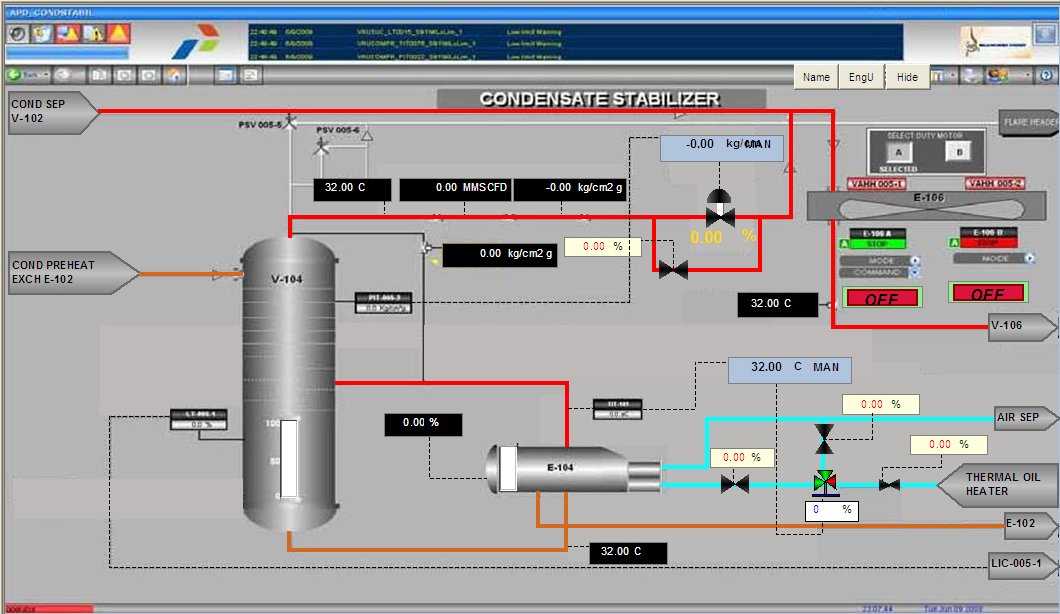
Sample - Condensate Stabilizer OTS
The model is capable of simulating the following operations:
- Start-up operations
- Normal steady-state operations
- Normal shutdown operations
- Emergency shutdown operations.
In addition to the above operations, the system is capable of simulating operations dictated by process disturbances and equipment failures introduced by the instructor.
The core element of any training simulator system is the simulation model of the plant unit operations and process controls. The UniSim system provides the ability to construct simulation model without computer programming knowledge by providing a library of building block modules used for simulating the behavior of devices such as pumps, columns, heat exchangers, valves, compressors, vessels and DCS control points. Major equipment types vary significantly from one plant to another. This variability is not generally in the overall functionality of the equipment, but in specific details such as geometry, configuration details, piping, service, etc. This variability greatly affects the operation of the equipment and hence the dynamic simulation of that operation.

Honeywell USO
The approach used in the UniSim system is to model the operation of such equipment using modules that are more fundamental. These modules contain a mathematical engineering model (based on first principles of chemical engineering) of the equipment type including heat, material and momentum balances, thermodynamic and operating equations, both algebraic and differential. Each equipment types can be further defined using equipment parameters that customise the module to reflect the actual operating and physical characteristics of the device.
The Instructor Station (I/S) is the control center of the simulator. The I/S allows access to the simulator’s special features, which do not exist at the actual site. These include:
- RUN, FREEZE and RESUME execution of the process model and control system representation in a completely time synchronized manner.
- SAVE and RESTORE model states for future retrieval.
- EXECUTE the model FASTER or SLOWER than real time.
- Introduce malfunctions.
- Initiate scenarios.
The I/S interface also lets the instructor monitor the progress of the training session with lists and trends of process and control system variables.

Honeywell USO


 Posted by Wata
 Wata - Malaysian Oil and Gas Engineer