April 15, 2008
Hmm, it’s 10 in the morning, and I’m at the Kerteh Airport tea room. Yup, Kerteh does have an airport, though it’s unique in the sense that it is a PETRONAS owned facility rather than a Malaysian Airports Holdings Bhd asset. The only scheduled flights in and out of here are helicopters designated for offshore locations, and the twice daily Subang-Kerteh turboprop.
No, Kerteh Airport does not have a wifi hotspot, I’m surfing via my N95 and unlimited 3G access. Hey, there’s a business opportunity. Establish a wifi hotspot here, and those who have their own PCs can rent access to it.
I’m scheduled to go offshore, but there seems to be a dearth of choppers. Me and another 40 people are hanging around the airport, in the KIV category. Let’s hope that I can get on a chopper this afternoon, if not the next 2 hours waiting to see if I get on the 1400 flight is will be wasted.
What’s the engineering spin? I work for a consultant company, and when you cut a contract, you should make sure that hours spent in transit are chargeable. Considering the state of transport these days, at least you get some compensation for listening to muzak.
 6 Comments |
  business opportunity, Malaysia, oil and gas | Tagged: choppers, Kerteh, Kertih airport |
  Permalink
 Posted by Wata
April 13, 2008
Another week, another scan of the Saturday Star newspaper. Here’s an incomplete list of job ads in the paper:
Happy hunting. Let me have some feedback if you find this list useful. Even better, spread the news. PayPal donations welcome.
Leave a Comment » | business opportunity, engineering, oil and gas | Tagged: Chiyoda, ESSO, ExxonMobil, GPS, optimal, oval, sgs, star | Permalink
Posted by Wata
April 12, 2008
I recently performed an internal meter tube inspection using a tractor type system. It was great in allowing us to view the whole meter tube, all 20+ meters of it. As the tube was a single piece, we couldn’t take it apart and touch or visually inspect the inner surface with the naked eye.
Or naked eyes, as it were. Stereoscopic vision allows us to get a feeling of depth, assuming we can’t touch an object. From the images transmitted back to us by the tractor, it was unclear whether a blemish was a pit, a bubble or a surface mark. We were limited in the ability to view a spot at different angles, which would give us a better three dimensional feel.
This leads on to my question, why doesn’t someone invent a stereoscopic remote inspection system? It’s an old idea. It’s been done on a large scale (doesn’t get bigger than the sun), small scale (microscopes), so why not at a scale that is useful to us operational grunts?
2 Comments | business opportunity, engineering, oil and gas | Tagged: inspection, meter, nasa, stereo, tractor, visioneng | Permalink
Posted by Wata
April 10, 2008
Many people have questions about how a foreign engineer can register in Malaysia as an engineer.
The answer lies in the Registration of Engineers Act 1967 (Revised 2002), Section 10A.
My interpretation of the Section is as follows:
- Foreign engineers may only be registered as Temporary Engineers.
- A foreign engineer may only be registered if:
- he possesses the necessary qualification which is recognised for the practice of engineering as a professional engineer in the country where he normally practises; and
- he possesses the necessary expertise and his physical presence is required in Malaysia for not less than one hundred and eighty days in one calendar year or he is a resident representative of the foreign component of a joint-venture.
- The Board of Engineers may approve the registration of a Temporary Engineer for such period not exceeding one calendar year and may renew the registration as it deems fit.
- For the purpose of this section “foreign engineer” means an engineer who is not a citizen or a permanent resident of Malaysia.
So, how do you get around this if you don’t meet the requirements of the Act? Call yourself a ‘consultant’, ‘specialist’, ‘MD’, and other non-aggressive titles. You get the same pay anyway.
1 Comment | engineering, Malaysia, Uncategorized | Tagged: BEM, consultant, engineers, professional engineer, registration, specialist | Permalink
Posted by Wata
April 8, 2008
Liquid flowrate can be measured using two methods:
- Volumetric, where flow is directly measured (turbine meters), or calculated using other process variables (pressure differential in the case of orifice meters). In this case, the volume is multiplied by some form of density to get mass.
- Mass, which is measured using coriolis type meters. To get volumetric flowrates, the mass must be divided by density.
An example where confusion between the two types of methods can result in a financial or accounting problem is determining the amount of free water in a crude flowstream.
The volume fraction of water ismp typically determined on-site using a ‘shakeout’ method. A crude sample is extacted from the process and spun down in a centrifuge to get good separation between the crude and water. A de-emulsifier is typically added to break up the emulsion layer in the sample. The volume of water in the cylinder is the volumetric amount of water in the sample, say anything between 0.5 – 40%.
The details of the above method can be read up in the Manual of Petroleum Measurement Standards (MPMS), Chapter 10-Sediment and Water, Section 4-Determination of Water and/or Sediment
in Crude Oil by the Centrifuge Method (Field Procedure)
2 Comments | engineering, Malaysia, oil and gas | Tagged: coriolis, mass, measurement, MPMS, orifice, turbine, volumetric | Permalink
Posted by Wata
April 7, 2008
Another week, another scan of the Saturday Star newspaper. Here’s an incomplete list of job ads in the paper:
-
-
Giant is looking for management trainees in Kerteh, a prime oil and gas centre. I suspect that it will be located in the white elephant that will be called Kerteh Mall.
-
Pöyry is looking for a whole mess of people in Bangkok, Abu Dhabi, KL, Brunei. Disclosure: I work for Pöyry KL. Hey, apply and say you saw the advert here.
-
-
This is interesting. RasGas is recruiting, but using an agent in Jakarta.
Email address and
here.
Happy hunting. Let me have some feedback if you find this list useful. Even better, spread the news. PayPal donations welcome.
1 Comment | business opportunity, engineering, Malaysia, oil and gas | Tagged: ExxonMobil, Giant, Kerteh, Poyry, Qatar Petroleum, RasGas | Permalink
Posted by Wata
April 5, 2008
Full disclosure: I was a student at Cambridge (England, not the other Cambridge).
I noticed that, of all the other department tea rooms I went to, the tea pot in ChemEng dribbled the most. Is this done on purpose, to highlight that we as ChemEngs should not apply our skills indoors, but should go forth and find other tearooms to invade, and find something else to gripe about and inspire our collective juices?
For the non-ChemEngs, no drip teapots are sold here, and written about here and here.
The writer of the above article mentions that “tannin in the tea stains the surface of the inside of the teapot, this in effect in simple terms makes the surface smoother.” Now, a lot of money is spent offshore to increase the throughput of crude pipelines by reducing the amount of friction between the fluid and the pipe walls. A lower pressure drop means for a given arrival (anding) pressure, a given upstream pump can provide more flow (look up a typical pump flow-head diagram).
Is a tannin a miracle drag reducing agent?
3 Comments | business opportunity, engineering, oil and gas | Tagged: chem eng, crude, drag reducing agent, no drip, tannin, teapot | Permalink
Posted by Wata
April 4, 2008
Still commenting on the above article, I had some word on the map.
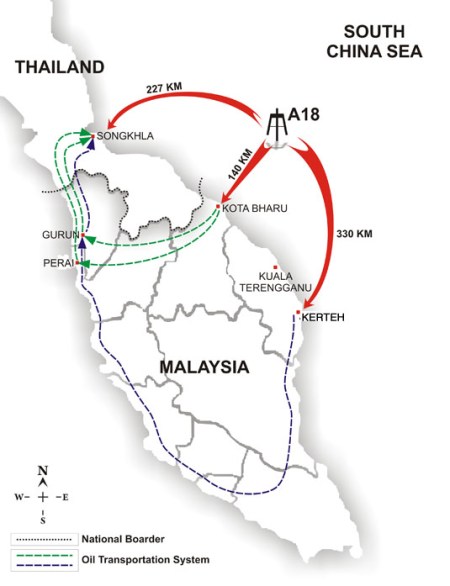
First thing I would like to point out is that the author says the green and blue line represents an oil transportation system.
At the moment, peninsular Malaysia has no oil transportation system. And there are no plans to have a consumer level transportation system (i.e. from refinery to distribution centre, to being piped into petrol stations and the like).
The blue line going from Kota Bharu to Gurun is possibly referring to the Trans-Peninsular Pipeline, which is getting a lot of press release last month (April, 2008). The pipeline will be used to transport crude from Yan to KB, with the intent of saving the travel time to send crude carriers around the Malaysian Peninsular via the Malacca Straits.
You can read articles on the commercial feasibility of the pipeline here and here.
4 Comments | engineering, investment, Malaysia, oil and gas | Tagged: Gurun, Kota baru, Kota Bharu, oil, trans peninsular pipeline, yan | Permalink
Posted by Wata
April 3, 2008
I earlier reported that TCOT / OSC were being handed over to PCSB. Now I can note that ExxonMobil Exploration and Production Malaysia Inc’s (EMEPMI) Production Sharing Contracts (PSC) were extended.
At 3:00 p.m. on Wednesday, March 26, EMEPMI signed with PETRONAS and PETRONAS Carigali the Main Principles Agreement that will lead to the execution of a new Production Sharing Contract (PSC).
In summary, the new PSC will enable EMEPMI to continue production of the existing reserves in the seven fields currently under the 1995 PSC until 2033. It will also be pursuing additional oil development and will have the opportunity to pursue Enhanced Oil Recovery (EOR) activities.
As part of the arrangement, EMEPMI will retain operatorship of all the existing offshore fields, and will extend this to 2033. Operatorship of the onshore assets, and in particular the Terengganu Crude Oil Terminal (TCOT), will be transferred earlier than initially planned, and will be accelerated from 2012 to no later than June 2009 along with the gas and condensate facilities (i.e. OSC). This transfer is strategic to PETRONAS due to national interest considerations.
Other aspects of EMEPM’s current onshore operations at Kemaman Supply Base will
remain as is.
9 Comments | business opportunity, engineering, Malaysia, oil and gas | Tagged: EMEPMI, EOR, KSB, OSC, PCSB, Petronas, psc, TCOT | Permalink
Posted by Wata

 Wata - Malaysian Oil and Gas Engineer