Where were you?

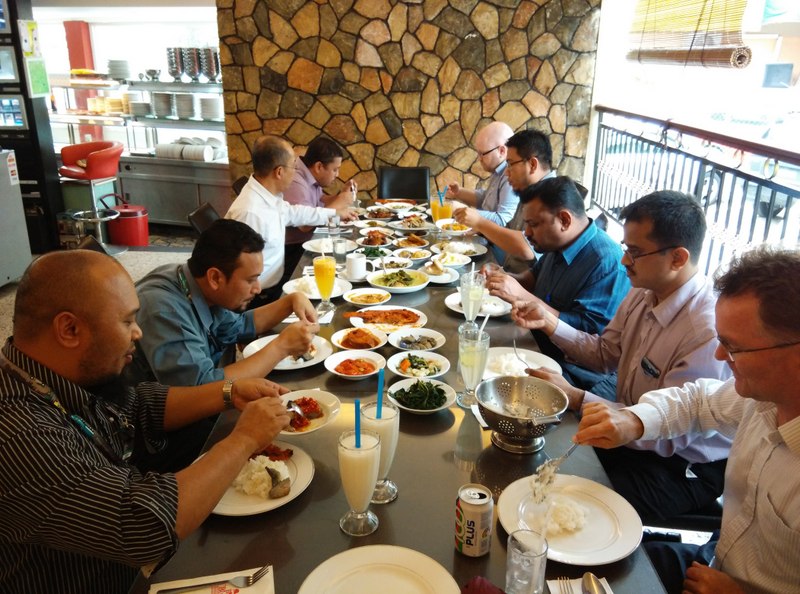
Where were you?
 Leave a Comment » |
  Malaysia, oil and gas | Tagged: measurement, metering |
  Permalink
 Posted by Wata
I would like to registar ‘Persaudaraan Pekerja Juruukur and Peruntukkan Malaysia’ with the ROS. Is there enough interest for a quorum?



Leave a Comment » | Malaysia | Tagged: allocation, measurement | Permalink
Posted by Wata
Nah, come see me first about your measurement needs. You know you want to.
Dateline 2013-11-11, Jakarta Post:
NEL has appointed Gilbert Tonner as Regional Manager as it launches its flow consultancy business in the Asia Pacific region. With inaccurate flow metering estimated to cost the industry billions of dollars per year worldwide, stakeholders are demanding greater accountability from oil and gas operators in the region.
Based in Kuala Lumpur, Malaysia, the new manufacturer-independent business will offer a range of unbiased training, testing and calibration support to oil & gas operators in Asia Pacific. This follows PETRONAS, the national oil company of Malaysia, awarding NEL a licence to operate.
…
Leave a Comment » | Malaysia, oil and gas | Tagged: measurement, NEL, Petronas | Permalink
Posted by Wata
Here’s a dramatically enhanced version of a true story.
An offshore Malaysian oil and gas asset (which shall forever remain nameless unless someone beats the truth out of me) has had some custody metering problems. They have not been able to prove their liquid turbine meters. So, someone from Operations Technical Support goes out to have a look.
The person steps up to the custody metering flow computers, stares at them, becomes one with them, and tells the platform technicians:
“Cool down the computers.”
It turns out that the control room where the computers are mounted and adjoining electrical room have a defective air conditioning system, something about leaking coolent pipes, and the room has been heating up. The flow computers were heated up enough such that electronic errors in the FCs were causing tolerances to be exceeded.
So portable A/C units were directed towards the FCs. Problem solved.
When you reach this level of CT Zen, then you can be called ‘guru’.
1 Comment | engineering, Malaysia, oil and gas | Tagged: flow computers, guru, measurement, offshore, zen | Permalink
Posted by Wata
Continuing on from my previous article, lets put a few numbers in:
Now, what does this mean? Well, if you measure the volumetric fraction of water, and assume that it is the same as the mass fraction, you will understate the mass of water in your sample. If your transactions are on a mass basis, than the amount of crude sold is overstated.
Engineering moral: not only are units important, the basis of measurement is important as well.
I’ll attach a short PowerPoint presentation that restates the numbers used above.
Leave a Comment » | engineering, oil and gas | Tagged: density, measurement, volume | Permalink
Posted by Wata
Liquid flowrate can be measured using two methods:
An example where confusion between the two types of methods can result in a financial or accounting problem is determining the amount of free water in a crude flowstream.
The volume fraction of water ismp typically determined on-site using a ‘shakeout’ method. A crude sample is extacted from the process and spun down in a centrifuge to get good separation between the crude and water. A de-emulsifier is typically added to break up the emulsion layer in the sample. The volume of water in the cylinder is the volumetric amount of water in the sample, say anything between 0.5 – 40%.
The details of the above method can be read up in the Manual of Petroleum Measurement Standards (MPMS), Chapter 10-Sediment and Water, Section 4-Determination of Water and/or Sediment
in Crude Oil by the Centrifuge Method (Field Procedure)
2 Comments | engineering, Malaysia, oil and gas | Tagged: coriolis, mass, measurement, MPMS, orifice, turbine, volumetric | Permalink
Posted by Wata
 Paypal donations accepted.
 Wata - Malaysian Oil and Gas Engineer