IChemE Interview – Pöyry Energy KL Graduate Engineer

October 15, 2008

(Did I tell you that I’m leaving Poyry and starting my own oil and gas consultancy in the New Year?)

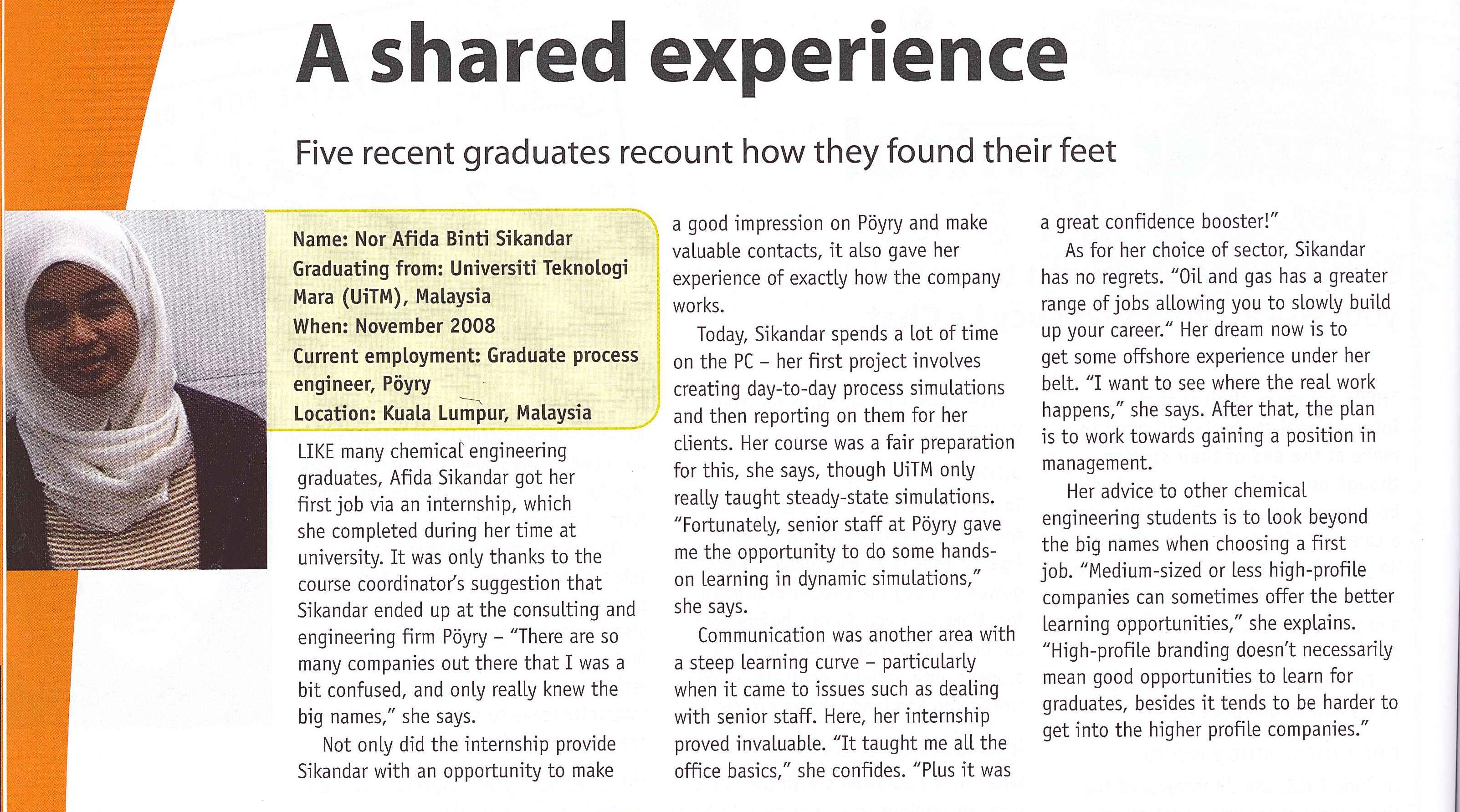
One of our lady engineers was interviewed by the IChemE.

IChemE extract - Afida Interview

IChemE extract - Afida Interview

It helps that the IChemE is renting space in our office 🙂

Note: I know they refer to Afida as Sikandar, and that this is in the October issue of TCE. Check out her graduation date, we grab them while they are hot!


Mentoring – How do you do it?

September 21, 2008

How do you mentor another engineer? As an example, the IEM has a mentoring scheme thats based around a logbook. The mentor meets up with the mentee at least once every 3 months, and reviews what the mentee has done. The mentor is meant to provide guidance as to whether the work done allows the engineer to develop.

When I go through a report, what I look for is:

  • Breadth of experience (I use the IChemE‘s report structure for this). The mentee should be exposed such as to develop her all her skills. This would mean the opportunity to explore as much as possible all engineering topics. Project management, safety, design, operations are just some of these.
  • Appreciation of engineering as a whole. A young engineer might think that running Hysys is cool, but you want them to understand why they are doing what they are doing. You don’t want to have only an technical software pilot, you do want an analysis as well. The tool is a means, not a ways.
  • Presentation of report. Engineers need to present their products. So clear writing skills and an proper flow is important. Highlighting important items and findings, and focusing on the deliverable would be something I would want to see.
  • General well-being. Is the mentee happy, is she getting enough support, is the mentor someone she wants to throw a brick at… you get the drift. The mentor should decide whether it is something she can help with, or the mentee should be able to deal with it herself with some tips of the trade.
  • Opportunity to influence exposure. You as a mentor should have enough clout to get  your mentee into projects or activities that help broaden their horizons.
  • Inspiration. It does help if you can get your mentee excited about work. Explain why they are doing the work that they do (need to build up experience, enhancing skills, exposure to client/site/software tools)

And you can do this more than once every three months, depending on the requirements. Engineers do get up and down days, you know.

IChemE 2nd regional safety seminar – Part II

July 23, 2008

Continuing on the same topic above, a presentation was delivered by Damain Peake, Sr Technical Safety Engineer, Shell E&P Asia Pacific entitled ‘Shell – Asia Pacific (EPA) operationalises HSE cases: major hazards communication and technical integrity’

  • Shell E&P AP portfolio.
  • Asset Integrity – Definitions
  • Technical Integrity – Definitions
  • Introduction to Safety Cases
    • Show all that hazards with the potential to cause a major accident have been identified, their risks have been evaluated and measures have been taken to control them.
  • Issues
    • Focus: SC used to capture all hazards, not just causes of major accidents.
    • Usability: SC unwieldy due to too much info.
    • Upkeep of SC, Management of Change (MOC)
    • Consistency of SC structure.
  • Framework to address Issues
  • Operationalise Shell E&P AP SCs.
    • Operating envelope and SC agreement
    • Institute maintenance schedule
    • MAH identified
    • Compliance to ALARP principles
    • Accountability
    • Remedial action plan and progress tracking
  • SC HSE section structure
    • Overview
    • Major Accident Hazards (MAH)
    • Equipment
    • Systems
    • Additional information
  • Best Practices
    • MAH and assessments
      • Best Practice Bow Tie – templates, electronically distributed and linked.
    • Hazard / Safety Critical Element (SCE) communication
      • Hazard control sheets.
      • Major accident pictures.
      • KPIs.
    • SCE and technical integrity
      • Change from facility description to SCE description
      • Describe how to keep the SCE operating.
      • Clear guidelines on how to manage SCEs when not fully functional.
  • Take home messages
    • Process safety – asset integrity (AI) intrinsically linked.
    • In operations, MAH management can only be ensured if technical integrity is ensured.
    • Operations HSE case have 3 main functions: communication, linkages, …
    • HSE lose focus.

IChemE 2nd regional safety seminar – Part I

July 19, 2008

I attended the above seminar on Monday, 14th July 2007. Interesting crowd, for once I felt that I was among my brethren of ChemEng.

I took some notes on the first presentation ‘PETRONAS – Enhancing chemical process safety in PETRONAS towards superior performance’ delivered by Kumar Karunakaran of Group Technical Services.

  • Introduction to PETRONAS
  • Introduction to Process Safety
  • Process Safety Enhancements in PETRONAS
  • Implementation approach
  • Implementation of new Roles and Responsibilities
    • Champions
    • Focal Person
    • Process Safety Aspect Custodian
  • The role of Situational Assessments (SA).
  • Problem areas discovered during SAs.
    • Control of Safety Interlocks & Protective System Bypasses.
    • Inconsistent Lock Out Tag Out (LOTO) application when used on non-electrical equipment.
    • Insufficient Pressure Relief Devices (PRD) performance evaluation.
  • Ensuring sustainability through monitoring and measurement
    • Establish Process Safety Community of Practice (CoP)
  • Key success factors.
  • Way forward.
Blue Spotted Stingray

Blue Spotted Stingray
