IEM OGMTD – Drilling Seminar

August 20, 2009

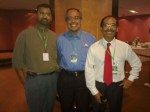
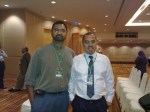
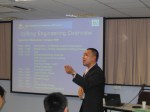
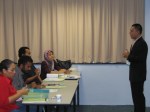
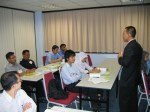
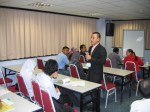
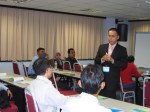
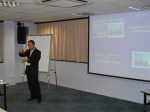
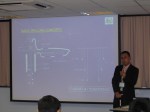
The Oil, Gas and Mining Technical Division of the IEM hosted a one day ‘Drilling Engineering Overview’ seminar on August 5, 2009. It was conducted by Mr. Abdul Razak Yakob and held at the Wisma IEM, attracting 21 participants.

Razak started out with an icebreaking session with the participants, enquiring as to their backgrounds and what the participants wanted to get out of the course.

He then kicked off his seminar with an overall background to the topic. He described the differences between onshore and offshore drilling, and presented photos of various drilling rigs available in the market. He introduced the rig management structure, showing a slide summarizing the various personnel manning the drilling operations.

Razak then discussed the different mechanical parts that make up the drilling equipment, whether on the rig floor or the support peripherals. Among the different equipment that were described was the Christmas tree, drill bit, drilling fluids, casing and cementing. An introduction to interpretation of logging results formed a part of the seminar, giving the participants a taste of analyzing well data. To provide some feel as to the information technology involved in drilling, the software suites used for data management, engineering and facilities integration was shown.

He then moved on to describe the well life cycle stages, which is construction, implementation, analysis and improvement.

Razak introduced the participants to the economical side of the operations, showing some shocking numbers. He then scared the living daylights out of us by providing some insight into the hazards associated with drilling.

Directional drilling was the next topic of the day.

A quick overview of drilling analysis was provided.  Participants were reminded of their undergraduate statics courses, where force balances, and torque plays an important part of the analysis.

Casing design was touched upon. This section covered the types of casing integrated into a well, and design considerations.  The importance of a correct cement job was discussed, as well as the analytical tests  to ensure the cement has the correct properties for the job.

Last but not least was more detail into the drilling fluids, and the required properties for different types of jobs.

The participants were from a mix, covering well grounded engineers who wanted to network and share experiences, to water wellbore engineers looking to see how different types of drilling technologies may be applicable to similar circumstances. And it is always a delight to see Razak in full flow.


Safety Notice – MLNG fatality

August 18, 2009

Strange I have to go to an overseas website to get the news. It was reported by Bernama as well.

At the Malaysian Liquefied Natural Gas plant in Tanjung Kidurong, Sarawak, 3 workers were overcome by gas while inspecting a large gas pipeline there, 1 of them has died, the condition of the other 2 in hospital remains unknown. 5th August 2009.


Saturday Star 2009-08-15 – Job Opportunities

August 17, 2009
  • First off, Synergy is looking for 5 lead safety engineers and 3 lead process engineers. Visit the Synergy website for contact details. And safety specialists. Ah, heck. If you have more than 5 years experience in O&G, apply. If you have less than 5, send a donation to the offshore account, and still get abuse.
  • Siemens “I won’t sell the future for quick profits” is looking for a Sales Manager, AP and Bid Manager, AP, presumably looking for some kind of profit. Send email here or apply via the website.
  • QP, ever dependable QP, is looking for a Maintenance Planning Engineer, Head Tech Support, Mech Eng, Rot Eng. Send email here, or visit the QP website. Did I tell you that QP’s SWB (salary, wages, benefits) package is something to be sneezed at?

Hmm, no particular place to recommend this week. So, let’s go back to the ever faithful Chee Meng’s. Last fling before Ramadhan?


From The Star – Transpeninsular Pipeline

August 16, 2009

Dateline 2009-08-13 taken from the Star:

The US$7bil Transpeninsular Pipeline (TPP) project that was to take off nearly two years ago may yet become a reality as a Chinese party is said to be keen to take a stake in the project with a shareholding agreement expected to be signed as early as tomorrow.

Malaysia - Transpeninsular Pipeline

Malaysia - Transpeninsular Pipeline

Maybe Synergy can propose doing the flow assurance for this pipeline… nah, it’s single phase, any university student who stayed awake during the compressible flow lectures should be able to do this.

You can subscribe to an online version of the paper at the Bluehyppo site, follow links to e-browse.


Safety Reminder – Accident Aftermath

August 14, 2009

No blood and guts are depicted in the following video, only large insurance claims. And with an soundtrack to boot.


Operator Training Simulators – Intro and Marketing

August 13, 2009

Here’s a little something that I wrote,

you might want to play it note for note…

Enough 80s already.

Operator Training Simulators

Operator Training Simulators (OTS) train operators on fundamental plant operations and improve their ability to optimize plant performance with the same simulation tool. OTS mirrors the exact look and feel of a plant, captures operator best practices, provides a standardized, level training ground to evaluate operator performance and enables operators to exercise best practices.

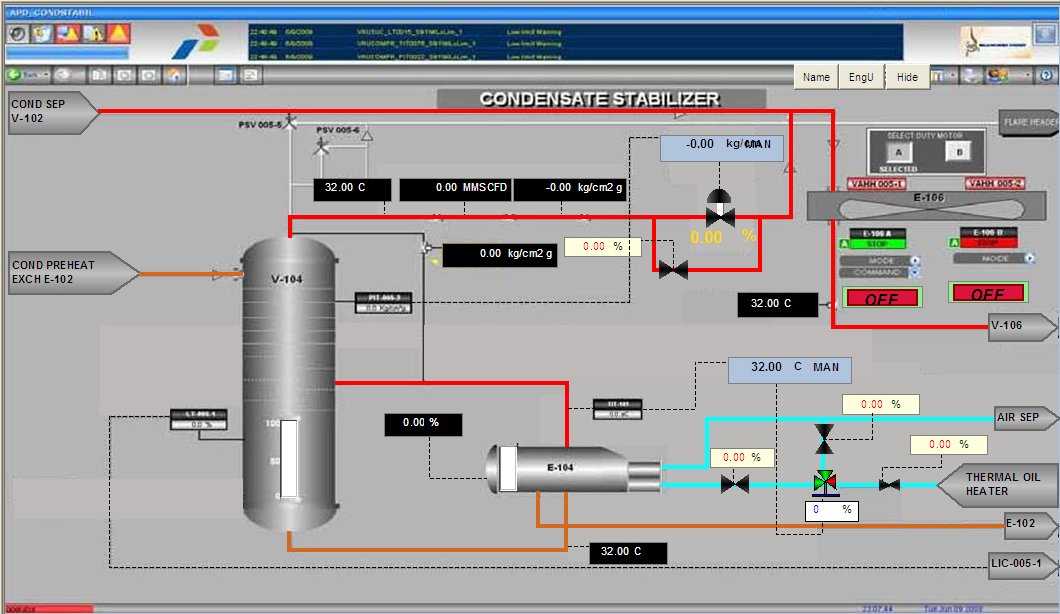
Sample - Condensate Stabilizer OTS

Sample - Condensate Stabilizer OTS

The model is capable of simulating the following operations:

  • Start-up operations
  • Normal steady-state operations
  • Normal shutdown operations
  • Emergency shutdown operations.

In addition to the above operations, the system is capable of simulating operations dictated by process disturbances and equipment failures introduced by the instructor.

The core element of any training simulator system is the simulation model of the plant unit operations and process controls. The UniSim system provides the ability to construct simulation model without computer programming knowledge by providing a library of building block modules used for simulating the behavior of devices such as pumps, columns, heat exchangers, valves, compressors, vessels and DCS control points. Major equipment types vary significantly from one plant to another. This variability is not generally in the overall functionality of the equipment, but in specific details such as geometry, configuration details, piping, service, etc. This variability greatly affects the operation of the equipment and hence the dynamic simulation of that operation.

Honeywell USO

Honeywell USO

The approach used in the UniSim system is to model the operation of such equipment using modules that are more fundamental. These modules contain a mathematical engineering model (based on first principles of chemical engineering) of the equipment type including heat, material and momentum balances, thermodynamic and operating equations, both algebraic and differential. Each equipment types can be further defined using equipment parameters that customise the module to reflect the actual operating and physical characteristics of the device.

The Instructor Station (I/S) is the control center of the simulator. The I/S allows access to the simulator’s special features, which do not exist at the actual site. These include:

  • RUN, FREEZE and RESUME execution of the process model and control system representation in a completely time synchronized manner.
  • SAVE and RESTORE model states for future retrieval.
  • EXECUTE the model FASTER or SLOWER than real time.
  • Introduce malfunctions.
  • Initiate scenarios.

The I/S interface also lets the instructor monitor the progress of the training session with lists and trends of process and control system variables.

Honeywell USO

Honeywell USO


PETRONAS Contractors Forum 2009 – My Summary

August 12, 2009

Yesterday was the photo session, today I’ll provide my views on the presentations and discussions. As I didn’t bring in any recording devices, the piece below focusses on what interested me.

I arrived late, so I missed the Welcoming Speech and Keynote Address. My apologies.

First talk I attended was an introduction to PETRONAS’s inhouse steady state process simulation software, iCON. The talk was given by Mr Shahrul Azman Zainal Abidin, Principal Engineer GTS. I have seen this presentation and derivations of it over the past 5 years (starting in 2004/5, when it was called PetroSIM), so nothing spectacular there. You can go visit the VMG site to pick up a brochure of the civilian version of this package. I was interested to note that they are working on a dynamic version of the package.

After the tea break, we were treated to an application of how iCON was used to investigate and optimise onshore gas receiving facilities, of which LCOT was one. What was interesting to me was that the result of doing the work inhouse resulted in a cost saving of RM382k (±10k), which give me a baseline as to how much to charge for a reasonably simple network, and 3 operating cases. Woohoo! This portion was presented by Mr Muzaimi B A Talib, Staff Engineer PCSB.

We went through an overview of the famed PETRONAS Technical Standards, led by Ir V.R.Harindran, Custodian Engineer GTS. Too bad they weren’t giving handouts, as it was an interesting trip down memory lane. Some items I took away from the presentation was:

  • PETRONAS subscribes and sends representatives to a lot of governmental and international standards bodies.
  • The PTS are designed to be ‘fit for use.’
  • There is opportunity to challenge the PTS during project execution.
  • PETRONAS is looking towards getting user feedback on the PTS. By feedback, I assume they mean something structured and ISO 9001 traceable, as opposed to shouting at the PTS on the engineering floor.

There was next a presentation by Mr Alex Zulkarnain B Zulkarim, Senior Manager GTS. His concern was the quality of engineering expertise in PETRONAS, especially among the junior rank and file. Items he touched on were:

  • PETRONAS wants to be seen as a savvy buyer (there go my generous markup margins).
  • PNAS needs to upgrade its technological expertise and has acknowledged that work needs to be done.
  • There is a proposal to station PNAS engineers in the service providers office as part of enhancing their technological skills.
  • His remit was pretty much focused on developing PNAS engineers, not Malaysian engineers.

After the crowd was tranquillised with lunch, came the contractors’ point of view. Ir. Rozali Ahmad, president of MOGEC, presented on MOGEC’s aims, intentions and events calendar. But all this was blown away by the list of challenges the engineering companies have when faced with PETRONAS as a client. You’ll have to get the list from MOGEC, if they ever own up to presenting it in the first place.


PETRONAS Contractors’ Forum 2009-08-10

August 11, 2009
Agenda PETRONAS Contractors Forum 2009

Agenda PETRONAS Contractors Forum 2009

I attended this session yesterday. Though it was a whole day session, ample time was provided to do networking, fishing, eating, spirited questioning (sorry for the blood on the wall), eating, photographs… did I mention eating?

PETRONAS Contractors Forum Group Photo


Kickdefella – To Cakerawala and Beyond – by Boat

August 9, 2009

I thought I’d post a link to Kickdefella’s blog entry where he writes about a visit to Cakerawala platform via boat flotilla, with members of the Kelantanese administration.

Nice night photo of the asset. And I see quite a lot of life jackets not done up properly.

I suspect CHOC’s internal memo writing staff are working themselves up in a fenzy about the unusual visit.


From Bernama – Kelantan Oil Royalty Issue

August 6, 2009

Taken from Bernama, dateline August 1:

KOTA BAHARU, Aug 1 (Bernama) — The federal government is looking into the question of oil royalty for Kelantan, Prime Minister Datuk Seri Najib Tun Razak said Saturday.

He said the matter was still under study because of overlapping areas in the vicinity of the oil platform.

“When the study has been completed, I will send a representative to convey the result of the study to the state government,” he told reporters after opening the Kota Baharu Umno Division delegates meeting, here.

Kelantan is seeking RM1 billion in oil royalty from the federal government, claiming that the money constituted five per cent of the earnings from petroleum and liquefied natural gas extracted from offshore Kelantan since 2004 as per a report of the Statistics Department.

What ‘overlapping areas’ are being referred to? I know that the Joint Development Area is part of Kelantan costal waters, but you would think division of profits would have already been sorted out with neighbouring governments. If not, I pity CHOC.

And which oil platform we talking about? Isn’t it a gas platform that’s out there. Chakerawala, anyone? Or maybe they are talking about oil equivalent barrels (oeb)?

Other articles on this are here and here.