Globalisation – Losing Engineers to Affiliates

May 18, 2008

I hear a lot about globalization, usually just before (or after, seeing I’m the last to know) colleagues and friends leave Malaysia for pastures green (dollars), tan (sand) or red/white/blue (choose your country).

Say you are an international company with a setup in Malaysia, and have affiliates and branches overseas. If an engineer wanted to quit, but you persuaded them to join up another affiliate in another country instead, would you consider that as a headcount lost to attrition, or take credit that the engineer is still ‘with the company’, and not really a loss.

Some items for discussion (let’s call the displaced engineer a floater):

  • Organisation – headcount = organisation – headcount, the way I understand it. A floater out of sight is out of the organisation’s mind.
  • Does the floater earn extra income for the original hiring company, ala MLM?
  • Now the org. company is short of an engineer earning revenue. Does the mother ship (i.e. headquarters) give it a discount or credit that it has generated a floater?
  • Is the floater ever coming back? In some organisations (in Malaysia, I guess ExxonMobil and Shell are two examples), the floaters are meant to come back higher up the management chain, bringing expertise and maturity to their home countries. How does that work for consultants or engineering companies? Oversea companies tend to be older and more established. Would management skills gained elsewhere and applied locally cause companies to be top heavy, to many chiefs, not enough workers?
  • Is there any guarantee that the floater will not use the foreign branch as a lauchpad to get a larger renumeration, as they probably now have PR status, or resident status. The floater can quit the overseas company and get more money (I call this a floater with a motor).
  • Do you get a lot of expats floating from other affiliates to Malaysia? It doesn’t seem very cost efficient to bring them in, unless they have skills that they can transfer (hah, tech transfer is a topic for a later blog).

Maybe we should all be floaters.


IEM OGMTD Talk – Reservoir Fluids

May 17, 2008

On Saturday, 10th May 2008, I attended a morning tea talk arranged by the Oil, Gas and Mining Technical Division of the IEM, of which I am the SecTreas. The talk was entitled ‘Overview of Drilling and Completion Fluids’. The speaker was Engr. Anwarudin Saidu Mohamed, currently a Coordinator for South East Asia Region with Drilling Fluids, a division of Baker Hughes Inc.

My colleague, Hui Hin, wrote up a summary of the talk. Visit her site to read her write-up.


Gaslift and Coffee Makers

May 16, 2008

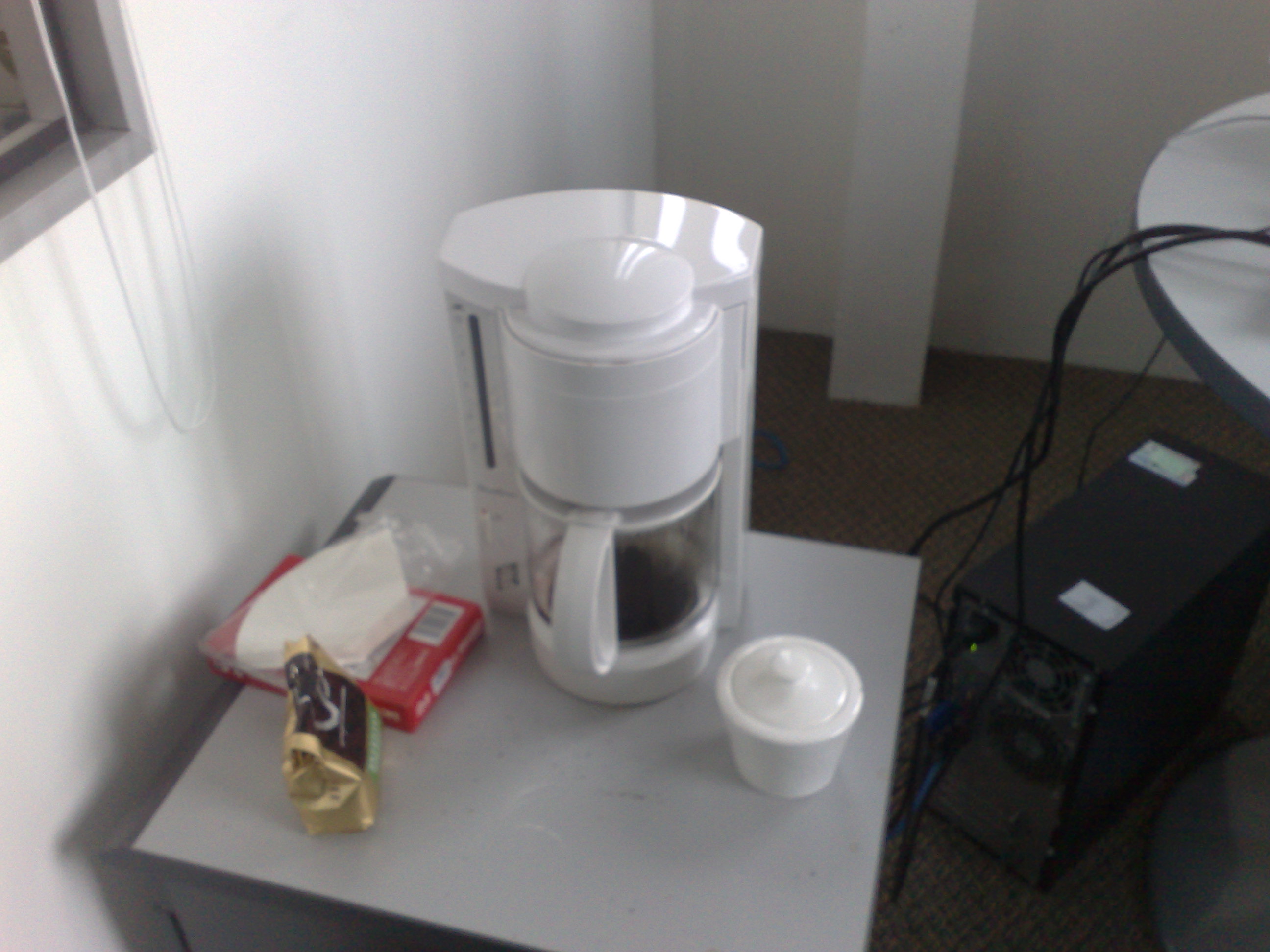
Wata\'s coffee maker

Us being engineers, after the installation of the first coffee maker in my offices (my personal machine Moulinex type W70, my office), the discussion wandered round to how exactly it worked.

Wikipedia - Gas Lift diagram Digressing, gas lift as defined in Wikipedia is “one of a number of processes used to artificially lift oil or water from wells where there is insufficient reservoir pressure to produce the well. The process involves injecting gas through the tubing-casing annulus. Injected gas aerates the fluid to reduce its density; the formation pressure is then able to lift the oil column and forces the fluid out of the wellbore.”

As far as I can tell, gaslifting is the only method used in the South China Sea, at least among the Malaysian platforms. Possible reasons are that it’s cheap (gas is always produced with oil out there in the deep blue) and gas is available at higher than required pressures. This is because gas is taken from the export gas line, which is compressed to transmission specs. As this is above gaslift pressure requirements, an additional booster compressor not needed.

The method used mainly on onshore wells is lifting oil with pumps, either mechanically driven (remember the donkey pumps seen in the background in Beverly Hills Cop II?) or electrically driven submersible pumps. Both require power, which is a premium offshore, but might be as close as the local power grid onshore.


Regressing back to my coffee maker, I find that the cold water reservoir is about the same level as the coffee pot. Hot water has to drip through the filter on top of the pot, and produce that black gold. So, how is the water sent up about 15cm? Definitely not with a pump.You’d hear it running, and pumping a hot two phase mixture is a good way to claim warranty about every other month.

Looking round, I find an article that explains that the hot water is carried up from the cold water reservoir through a pipe by rising bubbles of water vapour (formed by boiling water at the bottom of the pipe). This, and the reduction in density due to a liquid-gas mix, is the same process as a gas lift, though cheaper, on a smaller scale and smells a whole lot nicer.

So, oil and gas engineering principles may be found as close as your nearest cuppa. 


Interesting Fatwa for Chemical Engineers – Part III

May 15, 2008

Continuing from Part I and Part II, (The original article may be found here)

Ruling on using materials to which “animal glycerine” has been added

Question:

What is the ruling on using materials to which “animal glycerine” has been added, such as toothpaste, shampoo and body moisturizers. What is the ruling on mono-glyceride and di-glyceride, which are added to some kinds of bread? Is the basic principle that one should check or ask about the source of these materials, and find out whether they are animal or vegetable? Is checking on these things regarded as a kind of going to extremes? How should we respond to those who say that the basic principle is that a thing is permissible so long as it is not mixed with anything haraam? Or those who say that religion is easy and we should not go to extremes or ask too much?

Answer:

(…)

Thirdly:

If it is not known whether the animals whose meat is permissible but need to be slaughtered properly in order to become halaal were slaughtered according to sharee’ah or not, then the basic principle is that they should not be used, because the basic principle with regard to slaughtered meat is that it is haraam unless it is known that it is halaal. The Prophet (peace and blessings of Allaah be upon him) forbade eating game meat that had drowned in water because it was not known whether it died as the result of being hunted or from drowning. And he (peace and blessings of Allaah be upon him) forbade eating game caught by a dog whose owner had released it and mentioned the name of Allaah when releasing it, but he found other dogs with him. The reason for that is that it is not known whether it was his dog that caught it or the other dogs.

It was narrated from ‘Adiyy ibn Haatim (may Allaah be pleased with him) that the Prophet (peace and blessings of Allaah be upon him) said: “If you release your dog and mention the name of Allaah, if he catches something for you and you find it alive, then slaughter it; if you find he has killed it but has not eaten any of it, then eat it. If you find another dog with your dog and it has been killed, then do not eat, for you do not know which of them killed it. If you shoot your arrow and mention the name of Allaah, then (the game) vanishes from your sight for a day, and you only find the mark of your arrow on it, then eat if you wish, but if you find it drowned in water, then do not eat it.”

Narrated by al-Bukhaari (5167) and Muslim (1929).

Ibn al-Qayyim (may Allaah have mercy on him) said:

… The ruling remains in effect unless there is evidence to the contrary, such as the ruling on tahaarah (purity), the rulings on breaking wudoo’, the ruling on remaining married, the ruling on possession and the ruling on commitments, all of which remain in effect unless there is evidence to the contrary. This principle is indicated in the hadeeth in which it is said concerning hunting: “If you find it drowned, do not eat it, for you do not know whether the water killed it or your arrow,” and “But if there are other dogs with him, then do not eat it, for you mentioned the name of Allaah over your dog, not any other.”

Because the basic principle concerning meat is that it is haraam, and there is some doubt as to whether the condition that makes it permissible was fulfilled or not, the game remains haraam as it originally was.

I’laam al-Muqawwi’een (1/339, 340).

Fourthly:

If the substance is artificial or of vegetable origin, it is permissible to use it in these products unless it is harmful or poisonous either in and of itself or when added to other substances.

Shaykh Muhammad ibn Saalih al-‘Uthaymeen (may Allaah have mercy on him) said:

There is nothing wrong with lipstick, because the basic principle is that it is permissible unless it becomes apparent that it is haraam. … But if it becomes clear that it is harmful to the lips, because it dries them out, then in this case it is not allowed. I have been told that it may dry out the lips. If that is proven then one is not allowed to so something that will harm oneself.

Fataawa Manaar al-Islam (3/831).

(continued)


Saturday Star 08-05-11 – Job Opportunities

May 12, 2008

Another week, another scan of the Saturday Star newspaper. Here’s a list of job ads in the paper:

  • IEV is looking for an Operations Engineer. You can apply via email here.
  • Qatar Petroleum is looking for a whole mess of engineers. CVs to be submitted here, though I hear the package isn’t that impressive.
  • RasGas is looking for measurement engineering specialists, mech eng specialists and Snr rotating eqt eng. CVs to be submitted here. I believe RasGas is a JV, one of the partners being ExxonMobil.
  • Murphy Oil is looking Graduate Trainees, surprise surprise. I thought they only went for senior staff, and paid big bucks for them. Times must be a-changing. I also remember one of their senior staff saying, if you quit from Murphy, you’ll never get back in. CVs to be submitted here.
  • Here’s a new one, though I think I have heard of them before. GL Konsult (“We VALUE and Enhance TALENT!”) is looking for everyone. I would say that they are either starting operations, or are a manpower supply house. Anyway, forward a detailed resume with photo here.
  • Shell is looking for graduates. Head to their website and follow Students & Graduates → Gradutes → How to Apply → Register & Apply Now → Register.
  • And of course, IGL Process Solutions is looking for high paying work, preferably of a 6 month duration.

Happy hunting. Let me have some feedback if you find this list useful. Even better, spread the news. PayPal donations welcome.


Professional Engineer – CE Update

May 11, 2008

I was in Port Dickson on the 21st to 23rd March 2008, contributing to a workshop to prepare a question bank for the Competency Exam, CE (I know, this was a while ago, I just found my notes).

The proposal is that all engineers applying to sit for the Professional Assessment Examination (PAE) after April 1st, 2008 with have to take the CE. It is targeted to have the first CE in June 2008, with at least three sittings per year.

The current outline of the paper is that it will split into 2 parts, a 3 hour general paper and a 3 hour paper related to the candidate’s engineering branch.

The general paper will cover The Engineers Act and Regulations, OSHA and Environment Quality Act (EQA). The branch paper will cover Uniform Building By-Laws (UBBL), and codes and standards pertaining to the engineering branch.

  • The general paper will consist of 2 sections. Section A will be 30 true/false answers, while for section B, the candidate has to answer 15 out of 20 subjective questions.
  • The branch paper will present 30 questions, out of which 20 need to be answered.

Note: I do not take responsibility if any of the above is altered. Ask your friendly IEM rep.


Interesting Fatwa for Chemical Engineers – Part II

May 10, 2008

Continuing from Part I, (The original article may be found here)

Ruling on using materials to which “animal glycerine” has been added

Question:

What is the ruling on using materials to which “animal glycerine” has been added, such as toothpaste, shampoo and body moisturizers. What is the ruling on mono-glyceride and di-glyceride, which are added to some kinds of bread? Is the basic principle that one should check or ask about the source of these materials, and find out whether they are animal or vegetable? Is checking on these things regarded as a kind of going to extremes? How should we respond to those who say that the basic principle is that a thing is permissible so long as it is not mixed with anything haraam? Or those who say that religion is easy and we should not go to extremes or ask too much?

Answer:

(…)

Secondly:

It may become halaal if the fat has turned (via some process) into something else, so that it is no longer called fat and does not have the characteristics of fat. If that is the case then it does not come under the same ruling. This is what the scholars call istihaalah (process to change a substance to something else) and it may be looked at from two angles. That which was good and permissible but has become bad and impure, is now haraam, and that which was bad and impure but has become permissible and good is now halaal.

Ibn al-Qayyim said:

Based on this principle, alcohol is impure, even though its origin is pure. If the reason for its being regarded as impure is no longer present, then it is to be regarded as pure. This is the basis of sharee’ah and the basis of reward and punishment.

Based on this, the correct analogy is that this principle may be applicable to all other impurities if they have gone through a process of change. The Prophet (peace and blessings of Allaah be upon him) removed the remains of the mushrikeen from the site of his mosque, but he did not remove the soil. And Allaah says of milk that it comes “from between excretions and blood” [al-Nahl 16:66]. The Muslims are unanimously agreed that if an animal eats impure things, but it is then detained and fed with pure things, its milk and meat become permissible. The same applies to crops and fruits: if they are watered with impure water, but are then watered with pure water, they become permissible, because of the change (istihaalah) in the impure thing, which becomes pure. The converse also applies: if the pure thing changes into something impure, then it becomes impure (naajis), like water, and food when it changes into urine and faeces. So how can the change affect it when good turns into bad, but not affect it when bad turns into good, and Allaah brings forth pure things from impure things and impure things from pure things?

It is not the origin of a thing that matters, but what it is now. It is impossible for the ruling on impurity to remain when the name and character of the thing have changed. The ruling is connected to the name and character, and is present or absent depending on whether they are present or absent. The texts which deal with the prohibition on dead meat, blood, pork and alcohol do not deal with crops, fruits, sand, salt, soil or vinegar, whether in wording or meaning or text or analogy. Those who distinguished between the change (istihaalah) of alcohol and other things said that alcohol becomes naajis because of the process of change, then it may become pure because of a further process of change. It was said to them that blood, urine and faeces became impure because of a process of change so they may become pure because of a further process of change. Thus analogy is in accordance with the text.

I’laam al-Muwaqqi’een (2/p. 14, 15)

In a statement issued by the Islamic Medical Sciences Organization in Kuwait – which discussed the issue of Haraam and impure substances in food and medicine, from 22-24 Dhu’l-Hijjah 1415 AH/ 22-24 May 1995 – it says:

[8.] Istihaalah (process of change) means that a substance changes into another substance with different characteristics, so an impure substance may change into a pure substance, and a haraam substance may change into one that is permissible according to sharee’ah.

Based on that:

Gelatin which is produced by the change of the bones, skin and tendons of impure animals is taahir and it is permissible to eat it.

Soap that is produced by the change of fat from pigs or dead meat becomes pure by means of this process and it is permissible to use it.

Cheese which is made by using rennet from dead meat of animals whose meat is permissible is taahir and it is permissible to eat it.

Ointments, creams and cosmetics that contain pork fat are not permissible to use unless there is certainty that the fat has undergone a process of change (istihaalah) and turned into a different substance. But if there is no certainty, then they are naajis (impure).

End quote.

For more information please see:

<http://www.islamset.com/arabic/abioethics/muharamat.html> [in Arabic].

(continued)


Costing – Hydrocarbon Production Opex

May 9, 2008

An important aspect of business is how much it costs to produce a product or service. To cover running (also known by the term operational or opex) costs, the cost of production must be less than the selling price of the product (okay, this is very basic). In operations, this covers SWB (salary, wages and benefits), maintenance costs, logistic costs, and others.

How much is the target cost for producing a barrel of oil is? Believe it or not, 10 USD / barrel is considered expensive. I think I’ve seen targets of 2.5 – 5.0 USD / barrel. If you know a better number, your comments are most valued.

Compare this to capital expenditure. The cost to drill and produce from an offshore well may range between USD 15-30M USD, which covers the gamut between a simple well to a horizontal, extended reach well. The smallest platform I’ve seen had at least 3 wells. Topside hardware costs probably start around 70M USD for a simple structure offshore, to the sky as the limit.

 And compare that to cost of engineering. Ah, we lot are an under-appreciated motley crew.


The Geek’s Geek – Fieldbus Home Computer Network

May 8, 2008

As a facilities engineer (usually known as an operations engineer to the rest of the oil and gas trade), I have to deal with instrumentation. I deal with old (aka proven) technology, so most of the gadgets I dealt with send signals via the good old 4-20 mA standard, which is reliable and very well understood.

This standard is old school. Current and upcoming field control technologies heading towards LAN-type data systems. One system you hear of often is the Fieldbus protocol. From the write-ups I’ve seen, it defines protocols for levels 1, 2 and 7 of the OSI model, which corresponds to the physical, data and application layers (read this excellent free book on TCP/IP). Ethernet defines levels 1 and 2.

So theoretically, you can swap up your cheap, off-the-shelf home Ethernet gear with industry standard Fieldbus equipment, as long as you can get software that is able to translate between the data and transport layer (layer 3). What’s stopping you?

If you were a real geek, you’d build a Fieldbus router to access the Internet, and maybe make it IPv6-ready as well.

Trivia: did you know that you can send power over Fieldbus lines?


Interesting Fatwa for Chemical Engineers – Part I

May 7, 2008

I thought that the following article was interesting to Muslim chemical engineers. The original article may be found here.

Ruling on using materials to which “animal glycerin” has been added

Question:

What is the ruling on using materials to which “animal glycerin” has been added, such as toothpaste, shampoo and body moisturizers. What is the ruling on mono-glyceride and di-glyceride, which are added to some kinds of bread? Is the basic principle that one should check or ask about the source of these materials, and find out whether they are animal or vegetable? Is checking on these things regarded as a kind of going to extremes? How should we respond to those who say that the basic principle is that a thing is permissible so long as it is not mixed with anything haraam? Or those who say that religion is easy and we should not go to extremes or ask too much?

Answer:

Praise be to Allaah.

Firstly:

The materials which are used to manufacture creams, shampoos, toothpaste and soap are either:

  1. Animal fats
  2. or other substances, of vegetable origin or artificial.

If the substance comes from animal fats, then it is of two types: 

  1. Either it comes from animals that are permissible to eat, and it has been slaughtered according to sharee’ah, or it comes from sea creatures that do not need to be slaughtered. The ruling in this case is that it is permissible, with no doubt.
  2. Or it comes from animals whose meat and fat are forbidden to eat, such as pigs, or it comes from a permissible animal but it has not been slaughtered in the proper shar’i manner, so it is “dead meat”. The ruling in both cases is that it is haraam, with no doubt.

The scholars of the Standing Committee said: 

If a Muslim is certain or thinks it most likely that meat, fat or ground bones of a pig have got into any food, medicine or toothpaste etc, then it is not permissible for him to eat it, drink it or use it. In the case of doubt, then he should not use it, because the Prophet (peace and blessings of Allaah be upon him) said: “Leave that which makes you doubt for that which does not make you doubt.”

Shaykh ‘Abd al-‘Azeez ibn Baaz, Shaykh ‘Abd al-Razzaaq ‘Afeefi, Shaykh ‘Abd-Allaah ibn Ghadyaan, Shaykh ‘Abd-Allaah ibn Qa’ood.

Fataawa al-Lajnah al-Daa’imah (22/281).

In a statement issued by the Islamic Medical Sciences Organization in Kuwait – which discussed the issue of haraam and impure substances in food and medicine, from 22-24 Dhu’l-Hijjah 1415 AH/ 22-24 May 1995 – it says:

[6.] Food substances which include pork fat in their ingredients which has not undergone any process to change it to something different, like some kinds of cheese, oils, fats, ghee, butter and some kinds of biscuits, chocolate and ice cream, are haraam, and it is not permissible to eat them at all, based on the consensus of the scholars that pork fat is impure (naajis) and it is not permissible to eat it, and because there is no need to consume this substance.

End quote.

(continued)