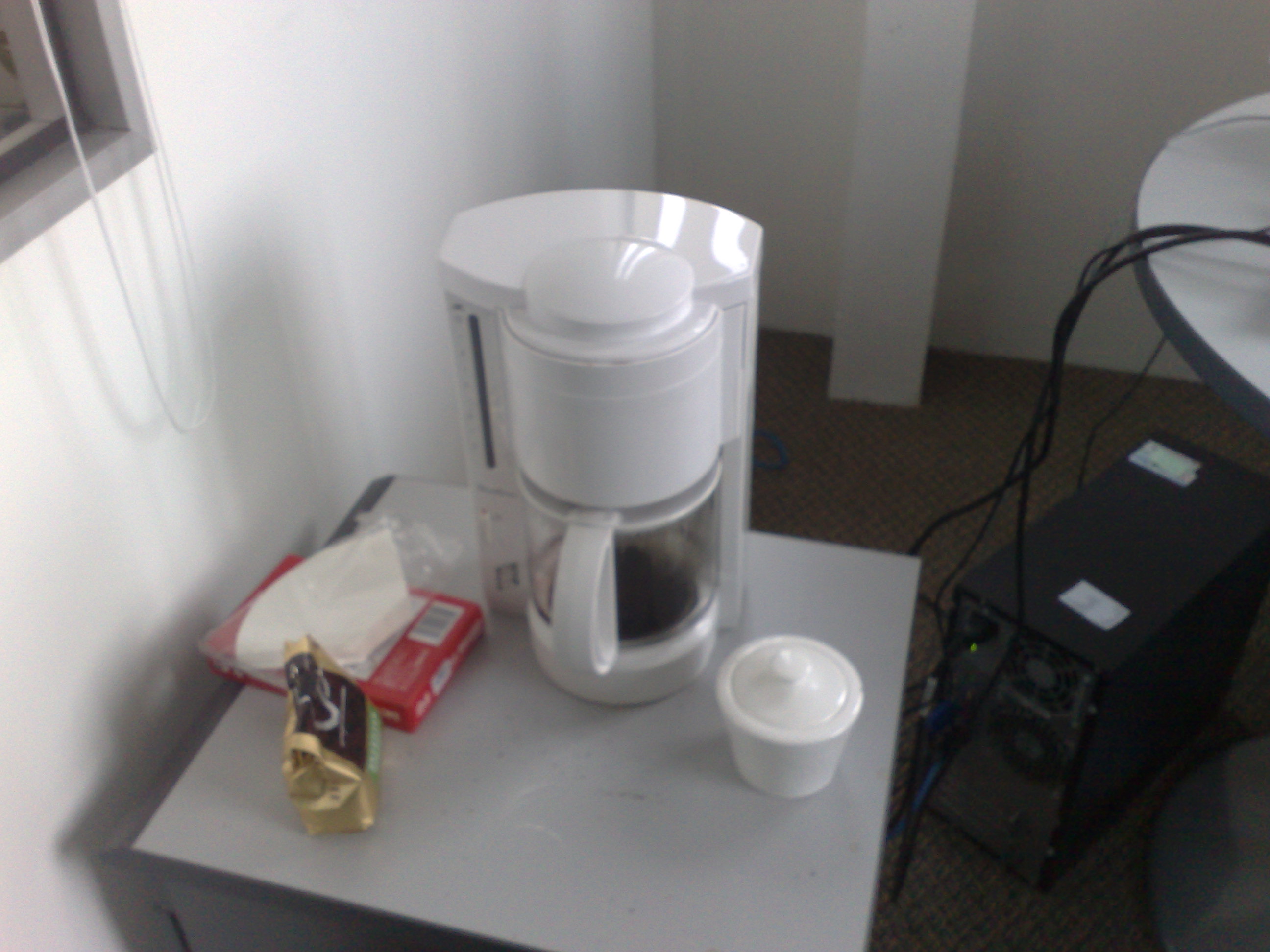
Us being engineers, after the installation of the first coffee maker in my offices (my personal machine Moulinex type W70, my office), the discussion wandered round to how exactly it worked.
 Digressing, gas lift as defined in Wikipedia is “one of a number of processes used to artificially lift oil or water from wells where there is insufficient reservoir pressure to produce the well. The process involves injecting gas through the tubing-casing annulus. Injected gas aerates the fluid to reduce its density; the formation pressure is then able to lift the oil column and forces the fluid out of the wellbore.”
As far as I can tell, gaslifting is the only method used in the South China Sea, at least among the Malaysian platforms. Possible reasons are that it’s cheap (gas is always produced with oil out there in the deep blue) and gas is available at higher than required pressures. This is because gas is taken from the export gas line, which is compressed to transmission specs. As this is above gaslift pressure requirements, an additional booster compressor not needed.
The method used mainly on onshore wells is lifting oil with pumps, either mechanically driven (remember the donkey pumps seen in the background in Beverly Hills Cop II?) or electrically driven submersible pumps. Both require power, which is a premium offshore, but might be as close as the local power grid onshore.
Regressing back to my coffee maker, I find that the cold water reservoir is about the same level as the coffee pot. Hot water has to drip through the filter on top of the pot, and produce that black gold. So, how is the water sent up about 15cm? Definitely not with a pump.You’d hear it running, and pumping a hot two phase mixture is a good way to claim warranty about every other month.
Looking round, I find an article that explains that the hot water is carried up from the cold water reservoir through a pipe by rising bubbles of water vapour (formed by boiling water at the bottom of the pipe). This, and the reduction in density due to a liquid-gas mix, is the same process as a gas lift, though cheaper, on a smaller scale and smells a whole lot nicer.
So, oil and gas engineering principles may be found as close as your nearest cuppa.

 Wata - Malaysian Oil and Gas Engineer
Is wata sharing the coffee?
Jabba always share, especially sharing the grief, torment and torture around.
I not only share, I’m sponsoring the coffee. I long for the day that Watabucks becomes a profitable company, but I’m not holding my breath.
Coffee Maker Review…
[…]Gaslift and Coffee Makers « Wata – Malaysian Oil and Gas Engineer[…]…